Last year I conclusively identified black cohosh (Actaea racemosa) growing nearby. At the same time, I was seeing more plants which looked so much like black cohosh and yet I wasn’t quite as sure about these plants. Were they really black cohosh?
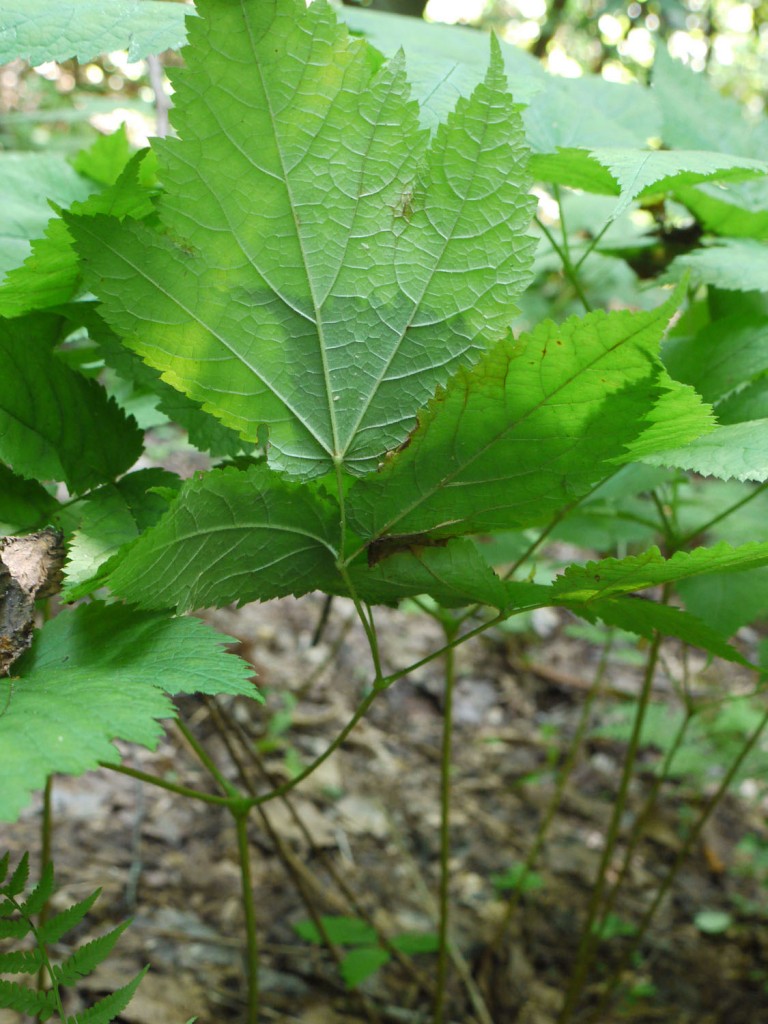
 Their leaves look the same . . . And their stems seemed to be the same also — with three stalks branching into three leaves having three to five leaflets:
 However, their flower stalk looked significantly different from the black cohosh. First. let’s look at the black cohosh flowering stalk:
 Next, here’s the flowering stalk for the “looks similar to” black cohosh plant:
 A typical description of black cohosh in a field guide (Newcomb’s Wildflower Guide in this case) says:
Flowers in 1 or several racemes 6″ or more long; found in woods. Tall plants with large leaves divided into numerous egg-shaped or oblong, sharply toothed leaflets. The white flowers appear to be all stamens since the petals are tiny and the sepals fall quickly. 3-8′ high. Flowers ill-scented; blooms from late June to August. The single pistil has a broad stigma.
The flowers definitely are “ill-scented.” Let’s get a closer look at the black cohosh’s “single pistil with the broad stigma” . . .
 The same field guide (Newcomb’s) includes an illustration of Goatsbeard (Aruncus dioicus) which looks like the unknown plant. The description reads:
White flowers in a large branching cluster of dense spikes 2-3″ long. The leaves are 2- to 2-times pinnate, with large, egg-shaped leaflets. 3-7′ high. Rich woods and banks.
 Maybe this is goatsbeard? Let’s look in another field guide for more comparisons and possibilities. The National Audubon Society Field Guide to Wildflowers gives a description of goatsbeard which includes the following statements:
Small, whitish-cream flowers in narrow, elongated spike-like clusters branching off a tall flower stalk. . . Leaves to 15″ long, compound, divided 2-3 times into toothed leaflets 2-5″ long. . . Flowers about 1/8″ wide; sepals and petals 5 each . . . male flowers with numerous stamens, female flowers with usually 3 pistils.
Here’s a closer view of the flowers after they’ve bloomed:
 Hhmm. Well this does not exactly look like the description given in the field guide. But wait, the Audubon guide has a bit more information . . .
The very similar False goatsbeard (Astilbe biternata) . . . has a lobed terminal leaflet on each leaf and two pistils.
Turning to the Audubon description for false goatsbeard, we read:
Small, white or yellowish flowers in elongated clusters branching off a hairy stalk; clusters collectively form a large, much-branched, terminal cluster. Flowers about 1/8″ long; petals 4-5; stamens 10; pistil 1, with separate styles, splitting into 2 sections. . . . Leaves to 2′ wide, compound, divided into 3 parts and again divided into 3 toothed or lobed, ovate leaflets; terminal leaflet usually 3-lobed.
Well, the two-style pistil and the lobed terminal leaflet are the confirming factors here. This “looks similar” plant is False goat’s beard (Astilbe biternata). For more confirmation, I would look at the USDA Plants Database site — along with a general Google photo search — to find additional photos and descriptions.
Now that I know these two plants — and know that their leaves are so similar I cannot distinguish the plants from each other — I realize the only way I can make a final determination of the plant’s identity is to see either the flowering stalk or the remains of the previous season’s flowering stalk. The tall one-two racemes with some leaflets at the base of the stalk tell me this is black cohosh. The spiky many-branched stalk tells me the plant is false goat’s beard.