Both White clover and Red clover are common throughout a number of continents. This post compares these two clovers.
The above image shows a patch of White clover (Trifolium repens) in early spring — before blooming. The compound leaves have three rounded leaflets with a white chevron.
White clover flowers begin blooming from the point closest to the stalk toward the middle of the flower head.

White clover (Trifolium repens)
In the next photo, the inflorescence on the right is just beginning to bloom while the left flower head is moving past its prime flowering phase.

White clover (Trifolium repens)
Here’s a close view of the flower head. Check out the individual flowers which are “pea-like” in shape.

White clover (Trifolium repens)
The next image illustrates a White clover plant with its smooth wiry stem and compound leaves. The stem for the inflorescence does not have any leaves.

White clover (Trifolium repens)
Here’s a very close view of the individual flowers within the upper part of the inflorescence.
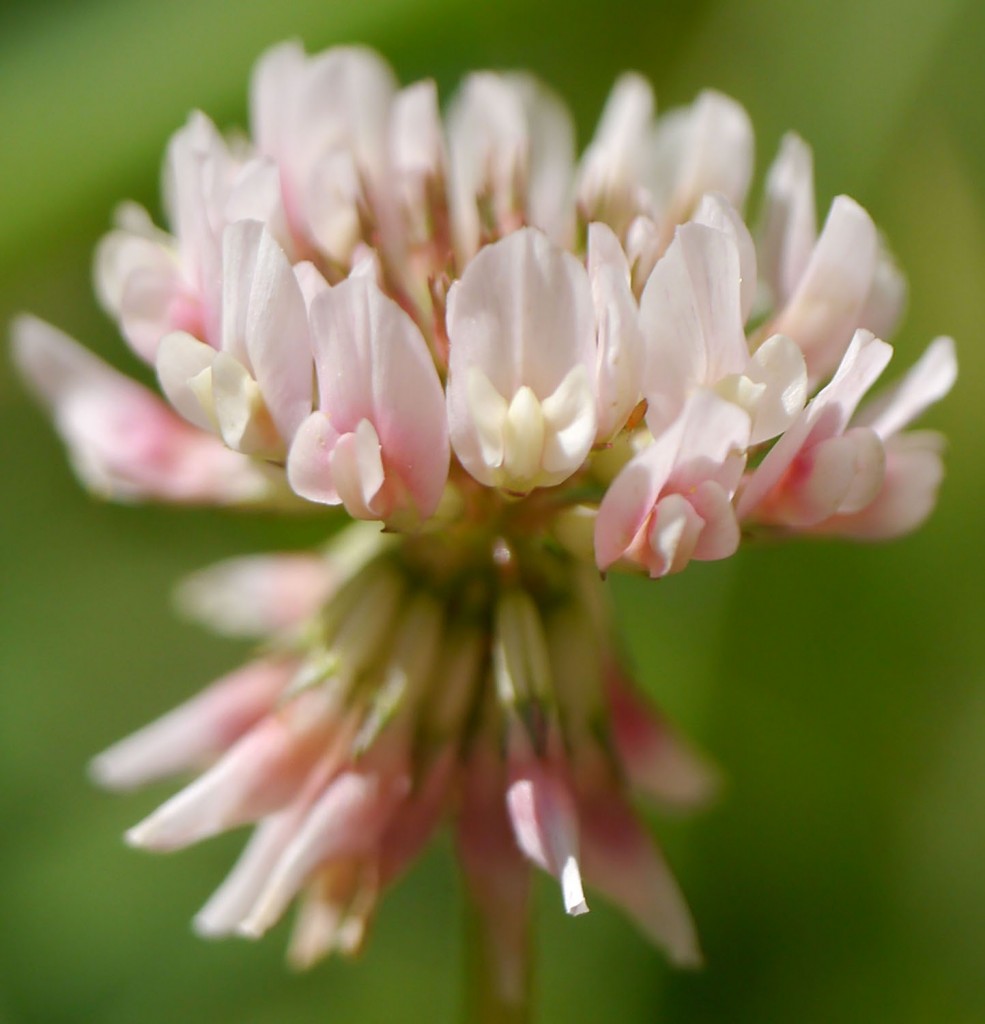
White clover (Trifolium repens)
As the initial flowers die back, they droop downwards from the flower head.

White clover (Trifolium repens)
After all the flowers have bloomed and wilted, they gradually turn from green to brown.

White clover (Trifolium repens)
The final image of White clover includes inflorescences in various stages of growth and die-back.

White clover (Trifolium repens)
Turning to Red clover (Trifolium pratense) . . . this plant is taller than White clover — with larger leaves (and leaflets) and larger flower heads. The leaflets are more oval-shaped (as compared to White clover leaflets’ round shape).

Red clover (Trifolium pratense)
As the inflorescence matures, its flowers also begin to bloom from nearest the stalk toward the center of the flower head.

Red clover (Trifolium pratense)
Red clover’s stem is rather hairy which becomes obvious when you look closely. Even the inflorescence and leaves may have fine hairs.
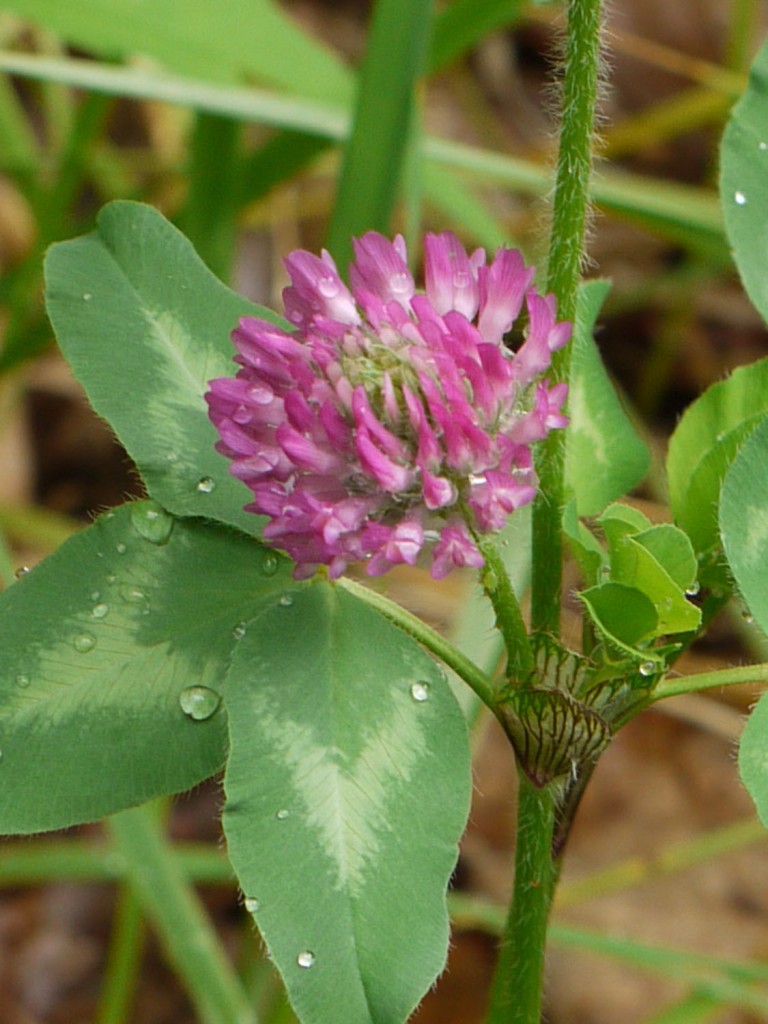
Red clover (Trifolium pratense)
Notice how Red clover has a compound leaf (three leaflets with those white chevrons) just below the inflorescence. If the flower head is at the top of the plant, the compound leaf is sessile (no stalk), while the inflorescence arising from the plant’s axil has a stalked compound leaf.
Look closely at the Red clover inflorescence to see the individual flowers.

Red clover (Trifolium pratense)
As the Red clover flowers die, they turn brown. They do not drop downwards as the White clover flowers do.

Red clover (Trifolium pratense)
Eventually, the inflorescence becomes a brown cluster of seed cases at the end of a dried stem.

Red clover (Trifiolium pratense)
Notice the fine threads and hairs intermingled with the dried seed cases.
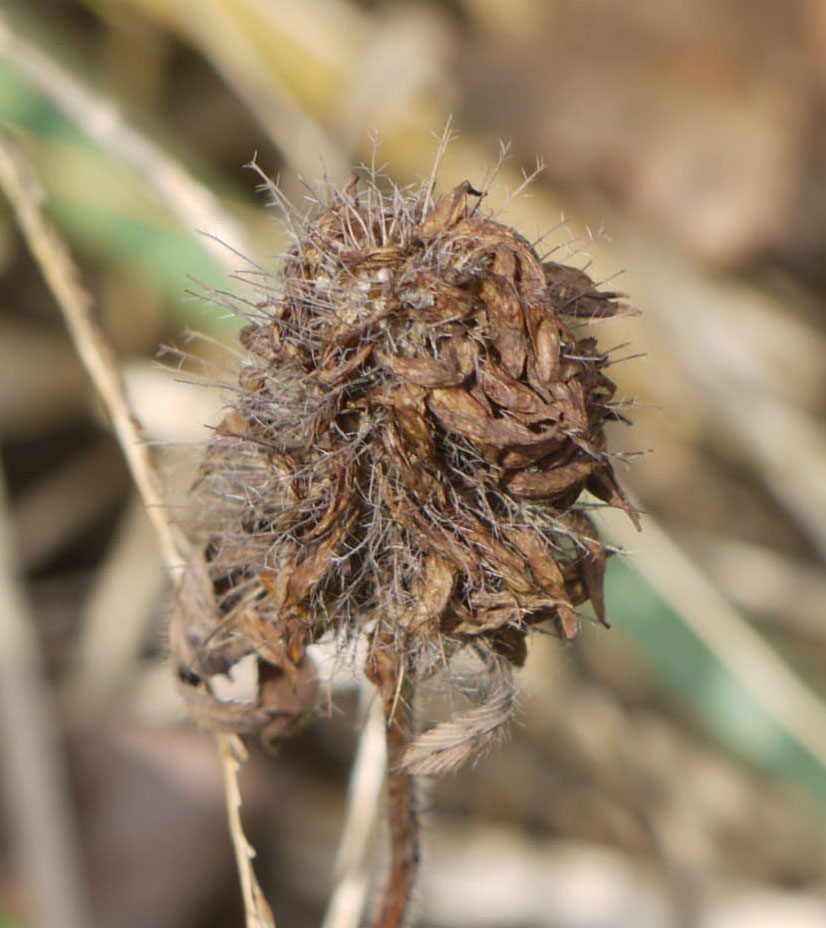
Red clover (Trifolium pratense)
This last image shows a patch of Red clover in various stages of growth.
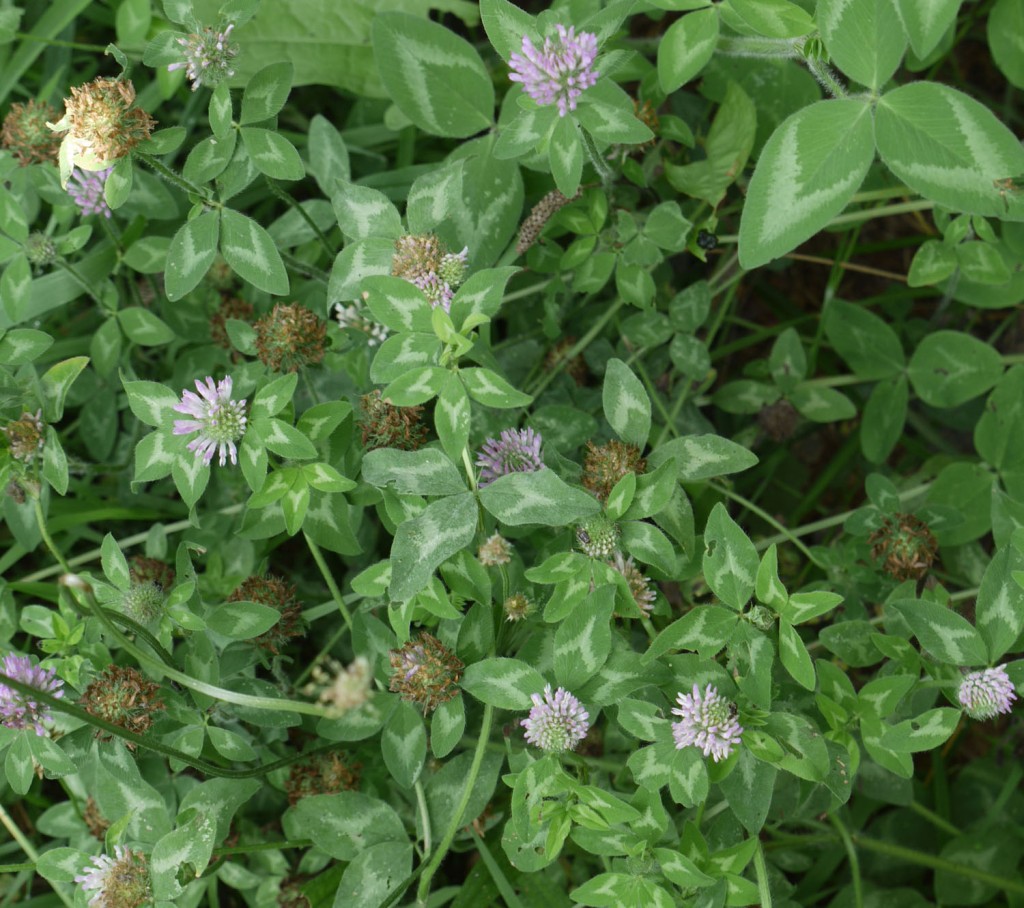
Red clover (Trifolium pratense)