The above photo shows a Blackberry (Rubus allegheniensis). It is frequently confused with Black raspberry (Rubus occidentalis). What follows is a series of side-by-side comparisons of these two plants. Blackberry is always on the left side while Black raspberry is shown on the right side.
First we’ll look at a group of plants for each Rubus species. Both have canes which develop roots at the tip when they get long enough to flop over and touch the ground.

Let’s check out the leaves.
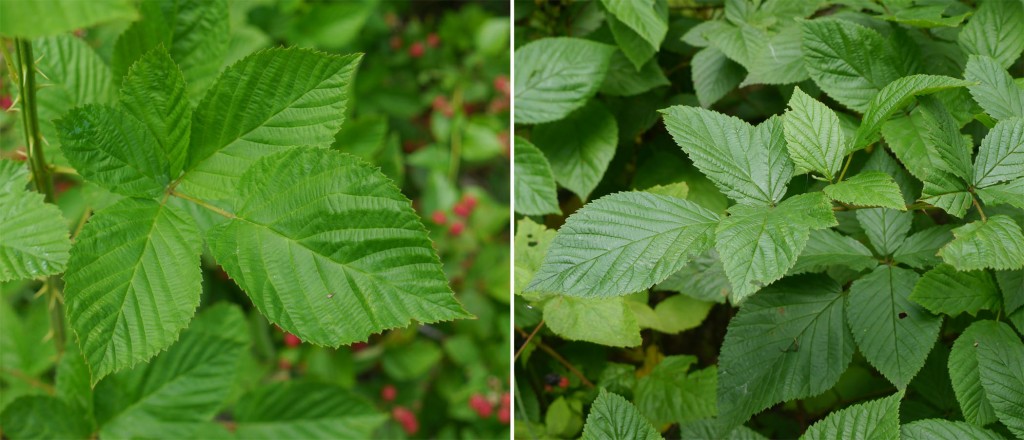
The overall leaf shape is quite similar. Both have compound leaves with 3-5 leaflets per leaf. Both sets of leaflets have pinnate venation and serrated margins. However, there is a significant difference between them. Look at the underside of their leaves . . .

Although the underside of Blackberry’s leaves are lighter than their upper side, the Black raspberry leaves are markedly lighter. They look almost white.
Next, let’s study the stems (or canes) of each plant.
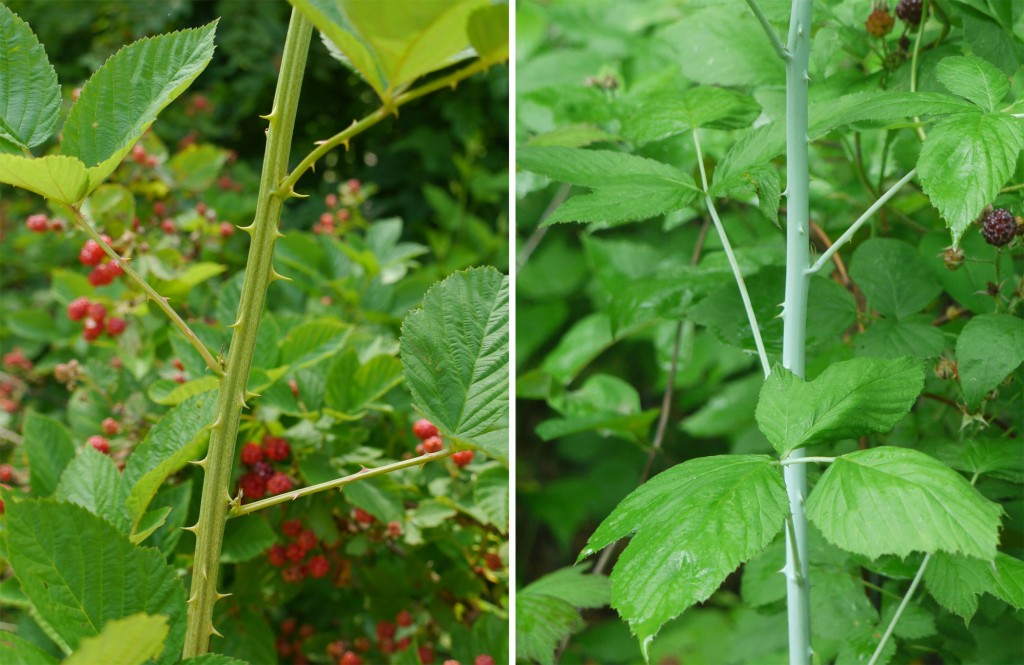
Both plants have leaves which alternate along the thorny stems. The Black raspberry stems are notably glaucous (bluish white). Another difference can be seen in a closer view of the stems. The Blackberry stems have ridges and angles while the Black raspberry stems are smoothly round-shaped (nearly circular in diameter).

Each plant’s thorns are different. Blackberry thorns are heavy-duty and definitely not to be tangled with whereas the Black raspberry thorns are somewhat less challenging due to their smaller overall size.
Now for the berries. Here are some green berries — beginning their development from the pollinated flowers. The differences between the two plants’ berries are subtle.

The berries begin to ripen and they still look quite similar.

When the berries are fully ripe, they turn almost black in color (hence each plant’s common name).

Let’s pick a berry from each plant.

And now we can see one more notable difference between these plants. The Blackberry fruit pulls away from the plant — leaving a rather flat receptacle on the plant. The Black raspberry fruit pulls away and leaves a sizable cone-shaped receptacle. (This is easier to see if you click on any of the photos and then zoom in with your browser’s “view” function.)
 Correspondingly, the Blackberry fruit is nearly flat across the part of the berry which was attached to the plant, while the Black raspberry fruit has a deep indentation in the berry.
Both fruits are edible and prized for jams, jellies and just plain eating as you pick.