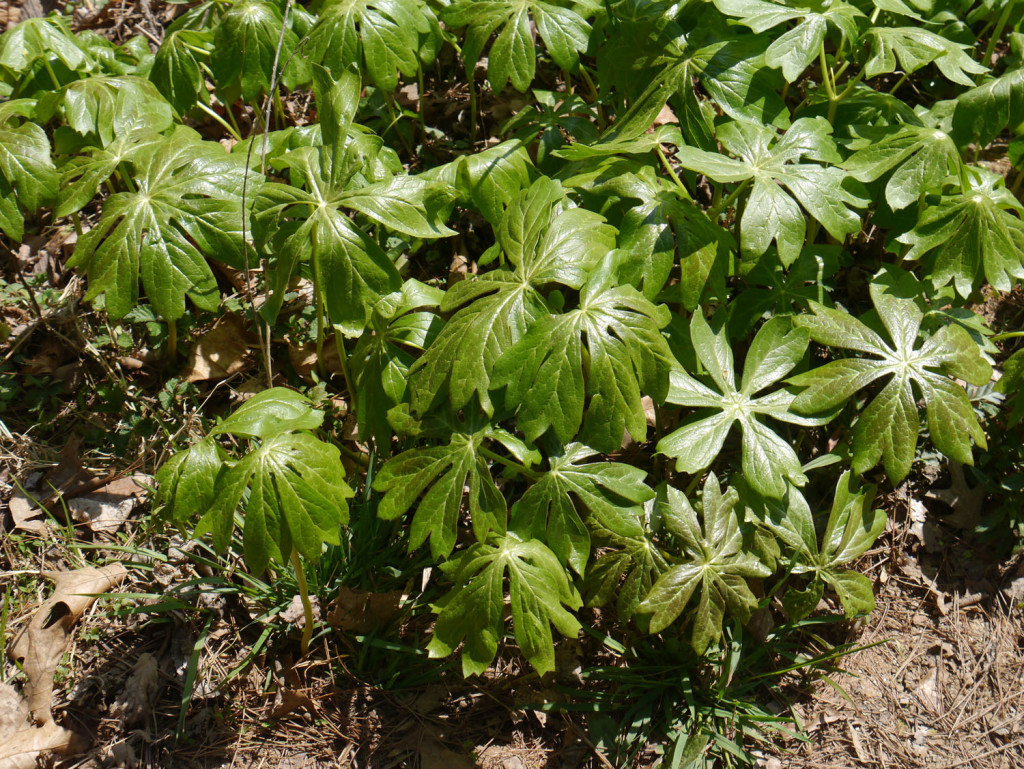
Many people recognize and could easily identify Mayapple (Podophyllum peltatum) when they see it in the woods (from the midwest through the eastern portions of North America). Its leaves seem quite unique with their peltate attachment of the leaf to the stem. “Peltate” means “shield-shaped; a flat structure borne on a stalk attached to the lower surface rather than to the base or margin” according to Plant Identification Terminology. Here are a couple more Mayapple leaves.
 Now if you came across this next group of plants in the woods somewhere in the southeastern portion of North America, I suspect you would be tempted to label it as another group of Mayapples.
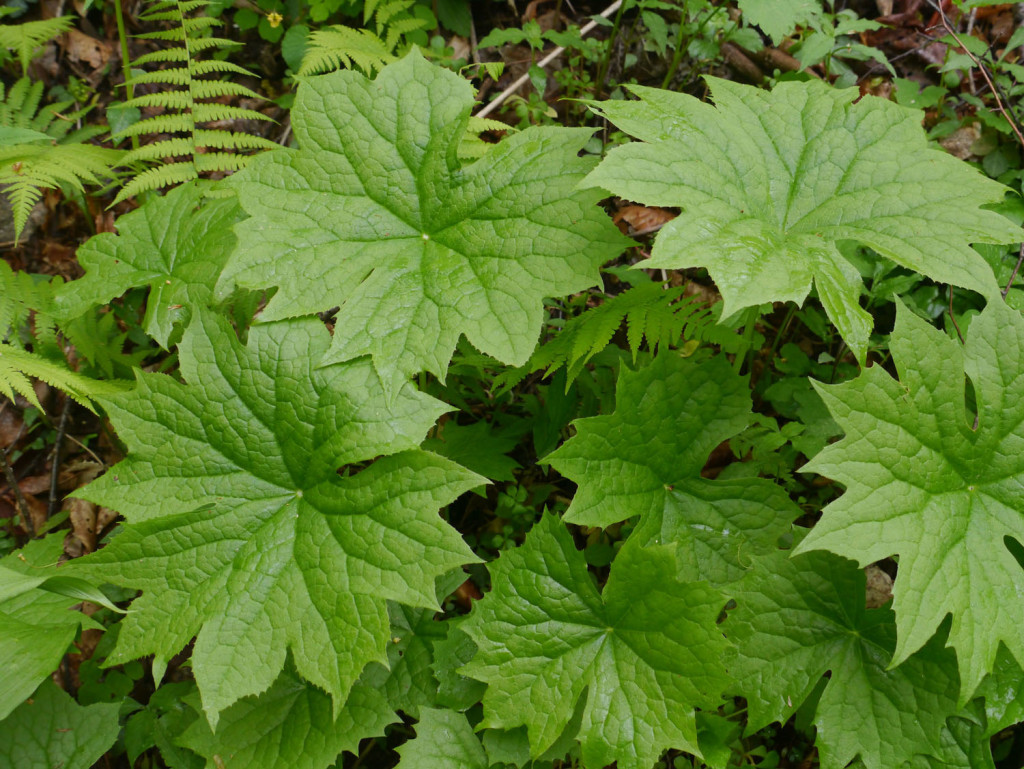 The leaves are large, they look peltate and they are growing at the same time of year as Mayapple.
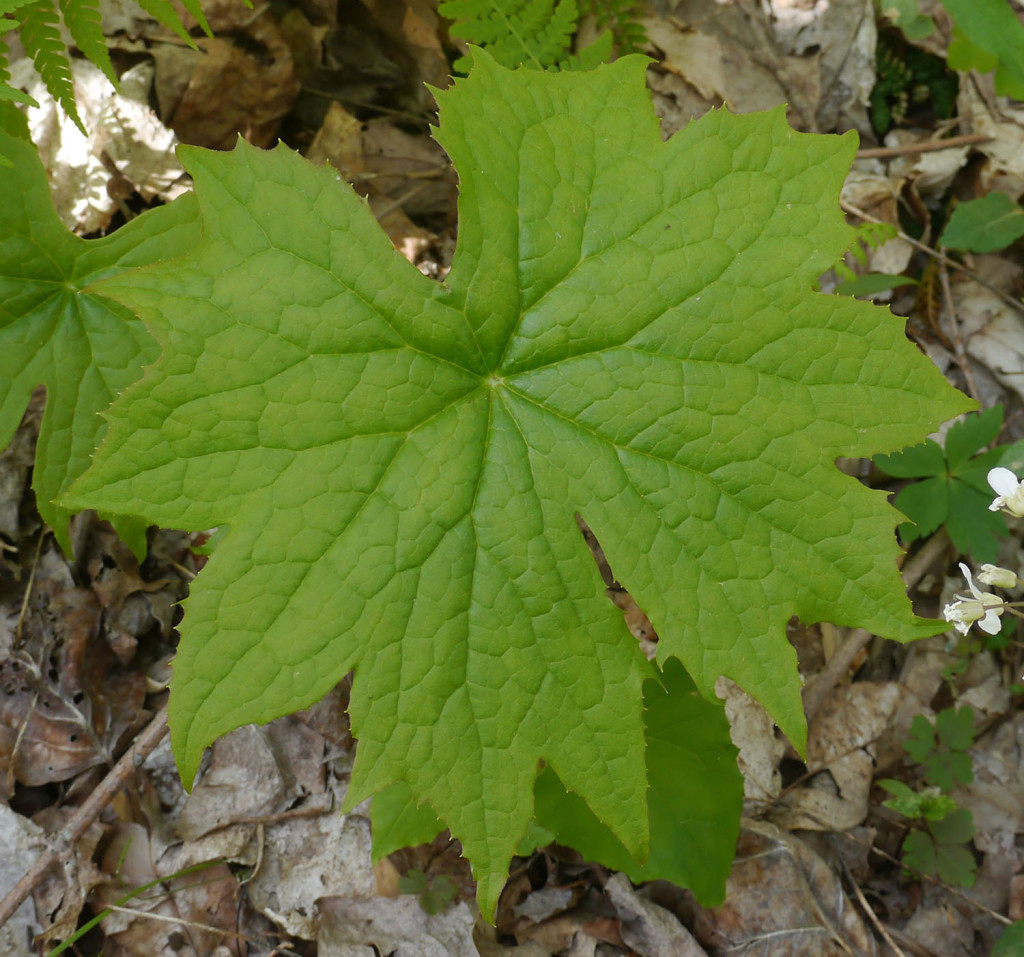
 However . . . this is a different plant entirely. It is called Umbrella leaf (Diphylleia cymosa). Let’s take a close look at a single leaf from each plant. First, the Mayapple.

Mayapple
Next, the Umbrella leaf.
Umbrella leaf
How would you describe each of these leaves? Both are peltate — with veins running from the stalk attachment point to the leaf margins. Both have toothed margins. However, the Umbrella leaf margins definitely look “sharper” with more toothiness to them. And the Mayapple leaf looks more deeply lobed. In fact, those deep indentations frequently go almost to the center of the leaf — which can be clearly seen in the second image above.
Looking at the underside of the Mayapple leaf, we can see the strong veins along with the point of attachment of the leaf to the stalk.

Mayapple
Umbrella leaf has a similar look to the underside of its leaf. However, notice the size of the leaf. On a mature plant, the leaves can be two – four times the size of a healthy Mayapple leaf.

Umbrella leaf
Here’s one more difference between these two plants. The Mayapple flower grows underneath the leaves. You have to lift the leaves up to see the flower (and later the fruit).

Mayapple
In contrast, the inflorescence of Umbrella leaf rises above the leaves.
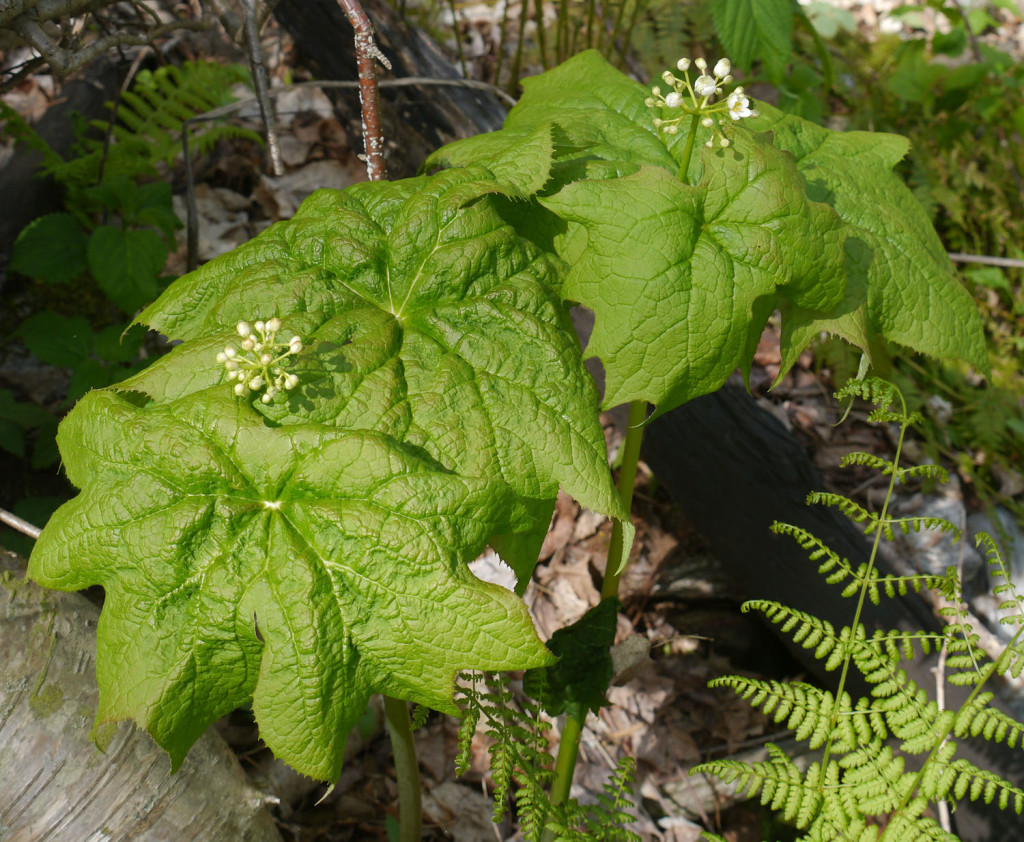
Umbrella leaf
This closer view of the Umbrella leaf inflorescence allows you to compare its individual flowers with the Mayapple flower shown above.
 If you see these plants when they are not in flower (nor fruiting), you may have to stop and study the leaves a bit to decide which plant you are viewing. Here’s a final image to allow you to decide which leaves belong to Mayapple (Podophyllum peltatum) and which belong to Umbrella leaf (Diphylleia cymosa).