The above photo shows a close view of a mature specimen of Common violet (Viola sororia). Recently, I saw some small green leaves and wondered if they might be violets returning after the bitter cold winter we’ve had. I was ready for some wild spring greens and knew that the Common violet was edible. As I reached down for the leaves, I stopped myself. Was this really a violet? Or was it Golden ragwort (Packera aurea) which is definitely not safe to be eaten? Here’s a photo of Golden ragwort later in spring.
Golden ragwort
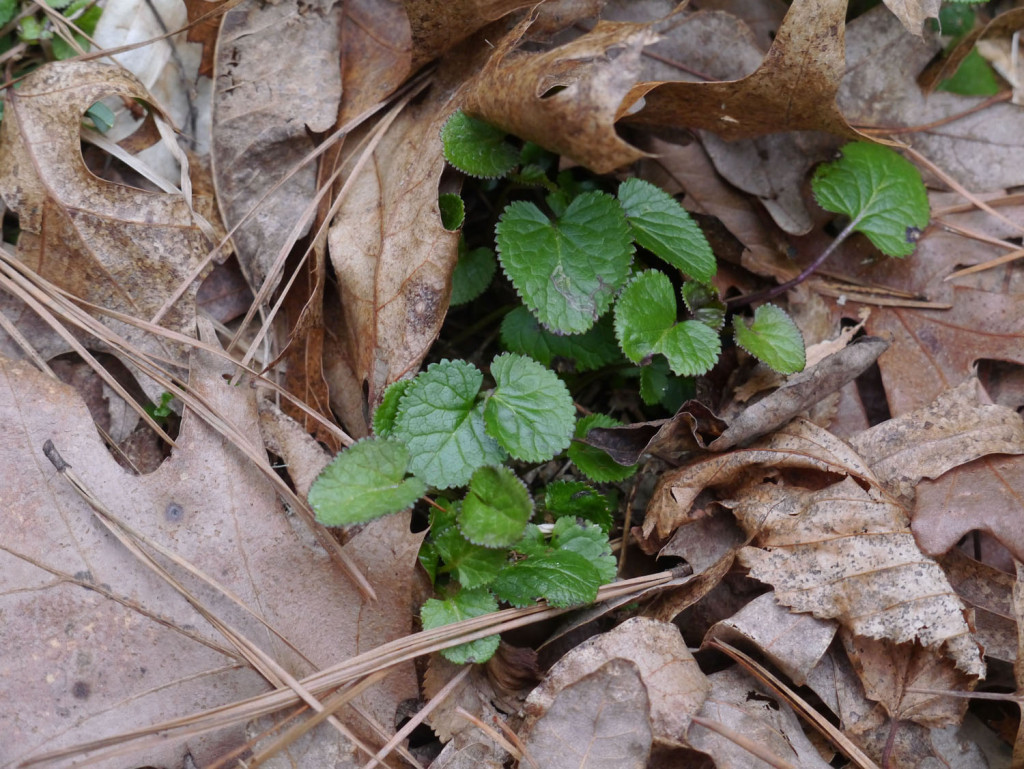
Since it was much too early in the season for flowers and leaves which are large enough for easy identification, I decided to inspect these leaves very carefully. Here’s another example of the small leaves I recently found:
 And what follows is a third set of small green leaves:
 At first glance, these are the same type of plant. The leaf shape is roundish with an indentation at the place of stem attachment so that they almost look heart-shaped. You can see how easily they might be confused with each other even though they are different plants.
Now, let’s get a really close look at the leaves . . . right next to each other.
 Both plants’ leaves have toothed margins. Both have palmate veins — veins arising from the stem attachment point.
What’s different is the type of teeth along the margins. (You might have to scroll up and down through all the photos to see this well.) Common violet’s leaves have tiny sharp points at irregular intervals. Golden ragwort’s leaves have regularly spaced teeth which remind me of a saw blade’s teeth.
Another difference lies with the venation patterns. Common violet most clearly has the palmate venation whereas Golden ragwort seems to have more of a central vein with other veins forking from it. Even though there are additional veins arising from the stem attachment point for Golden ragwort, still the overall sense is that of a singular, more prominent vein which the Common violet does not have.
The last distinction I would make is the fact that Common violet’s leaves are furled when they emerge and for some time thereafter. Golden ragwort’s leaves are much flatter. When each plant’s leaves mature, you can better see that Common violet has a pointed tip and thus resembles the heart-shaped form. On the other hand, Golden ragwort’s leaf shape remains rounded at the tip and therefore has an oval shape.
I apologize for not showing you the actual plant in question that I mentioned at the beginning of this post. It turns out I recognized it as a Common violet and nibbled its tiny leaves before I thought to take a picture of them.

 Hairy bittercress (Cardamine hirsuta) grows in many regions of North America — as an import from Europe. It is most evident during late winter and early spring months.
 After the flower stalk grows up from the center of Hairy bittercress, the leaves along the flower stalk look a bit different.
 The flower is very small — with four sepals, four white petals and four stamens.
 Once the flower has been fertilized, the long thin seed pods develop their tiny seeds. The seed pods split open, with the two sides of the pod curling away and releasing the golden-colored seeds.