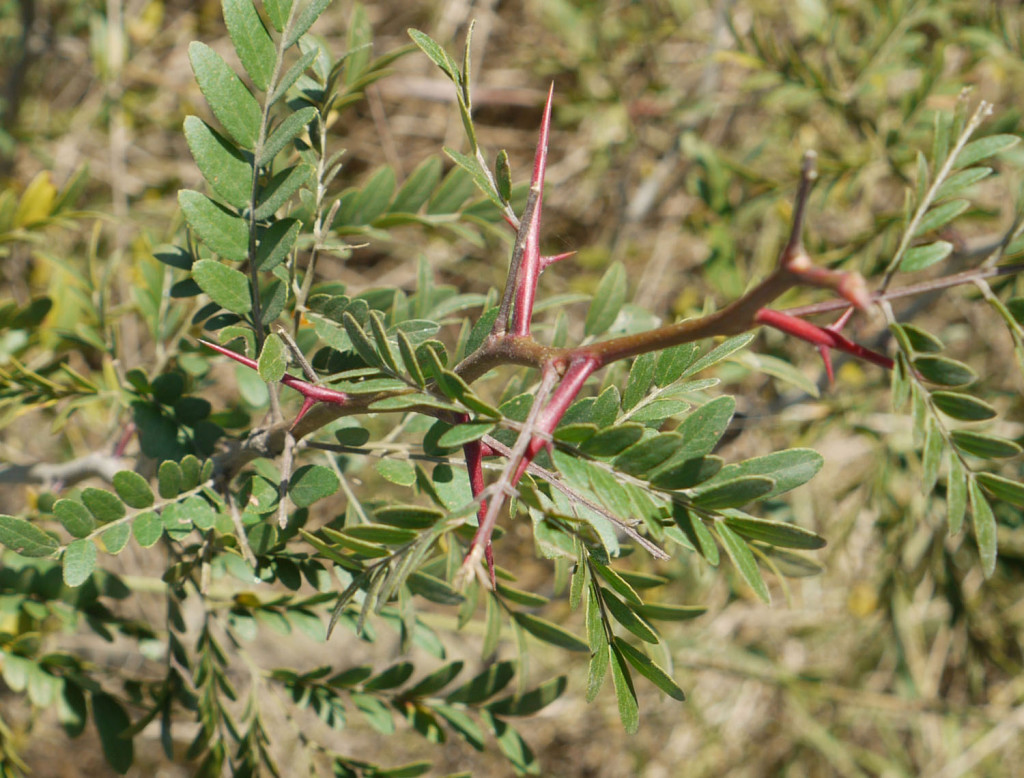
This is a young and healthy specimen of Honey locust (Gleditsia triacanthos). It has long red thorns along its branches. Here’s another close view of the thorns . . .
 On a mature Honey locust tree, clusters of these large, multi-branched thorns grow along the tree’s trunk. (The brown leaves in the background belong to an American beech–Fagus grandifolia.)
 The thorns are large enough to see at a some distance from the tree . . .
 Next, is another thorny locust (with similar-looking compound leaves). This is a very young Black locust (Robinia pseudoacacia). This specimen is so young that its new branches and thorns are both reddish in color.
 This next specimen of a Black locust branch shows its small thorns. The bits of green are newly sprouting leaves in the spring.
 And this image shows the thorns as they grow along the Black locust’s branches.
 Now look at the trunk of a maturing Black locust. In contrast to the Honey locust, this tree’s thorns are barely visible along the trunk.
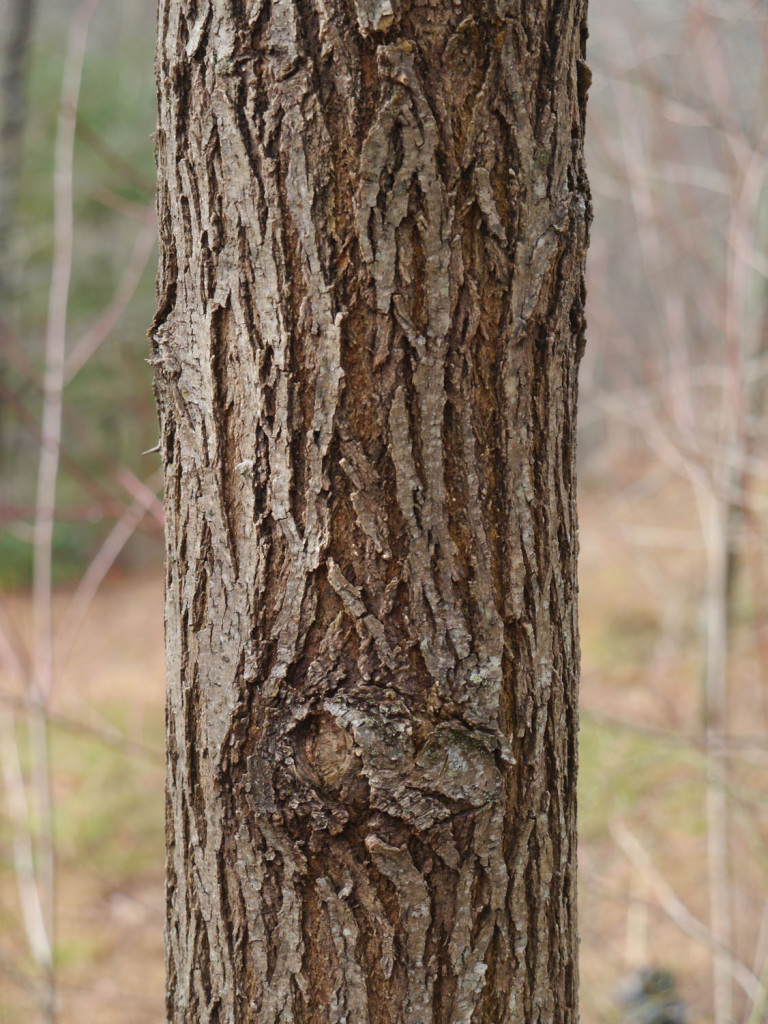 Just in case you couldn’t see the one visible thorn in the above image, here it is again in a closer view.
 Now for some botanical terminology with definitions from Plant Identification Terminology by James G. Harris and Melinda Woolf Harris. “Thorn” is defined as “a stiff, woody, modified stem with a sharp point; sometimes applied to any structure resembling a true thorn.”
“Spine” is “a stiff, slender, sharp-pointed structure arising from below the epidermis, representing a modified leaf or stipule.”
“Prickle” is “a small, sharp outgrowth of the epidermis or bark.”
And here’s another set of definitions — this time from How to Identify Plants by H. D. Harrington.
“Thorn. A stiff, hard, sharp-pointed emergence more deeply seated than a prickle. By some, differentiated from a spine in having vascular tissue.”
“Spine. A sharp-pointed rigid deep-seated outgrowth from the stem, not pulling off with the bark. . . Sometimes differentiated from thorn by absence of vascular tissue.”
“Prickle. A small, usually slender outgrowth of the young bark, coming off with it.”
One final set of definitions from The Kew Plant Glossary by Henk Beentje:
“thorn, 1. short pointed woody structure derived from a reduced branch; 2. often applied (wrongly) in a looser sense for any sharp structure on a branch”
“spine, a sharp-pointed, hardened structure derived from a leaf, stipule, root or branch, but always originating from the vascular or woody part. (Thorn is derived from a reduced branch, pointed structures from the epidermis are called prickles)”
“prickle, . . . a sharp outgrowth from the epidermis, detachable without tearing the organ”
Given these definitions, what term would you apply to the “thorns” of each of these locust trees?

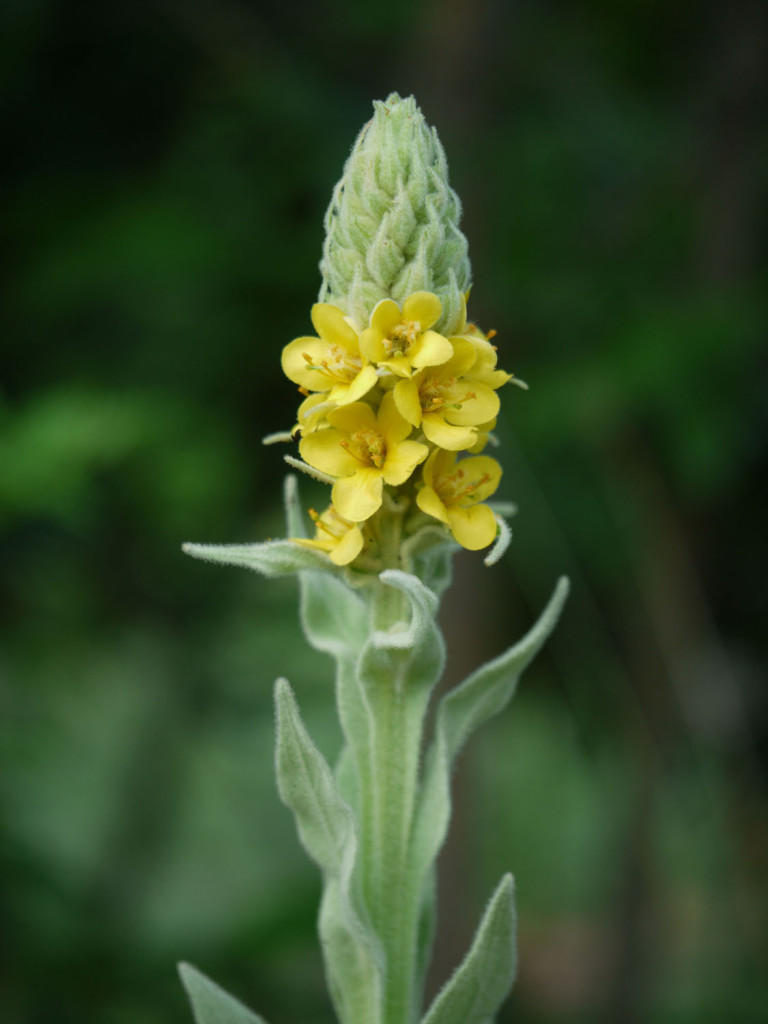
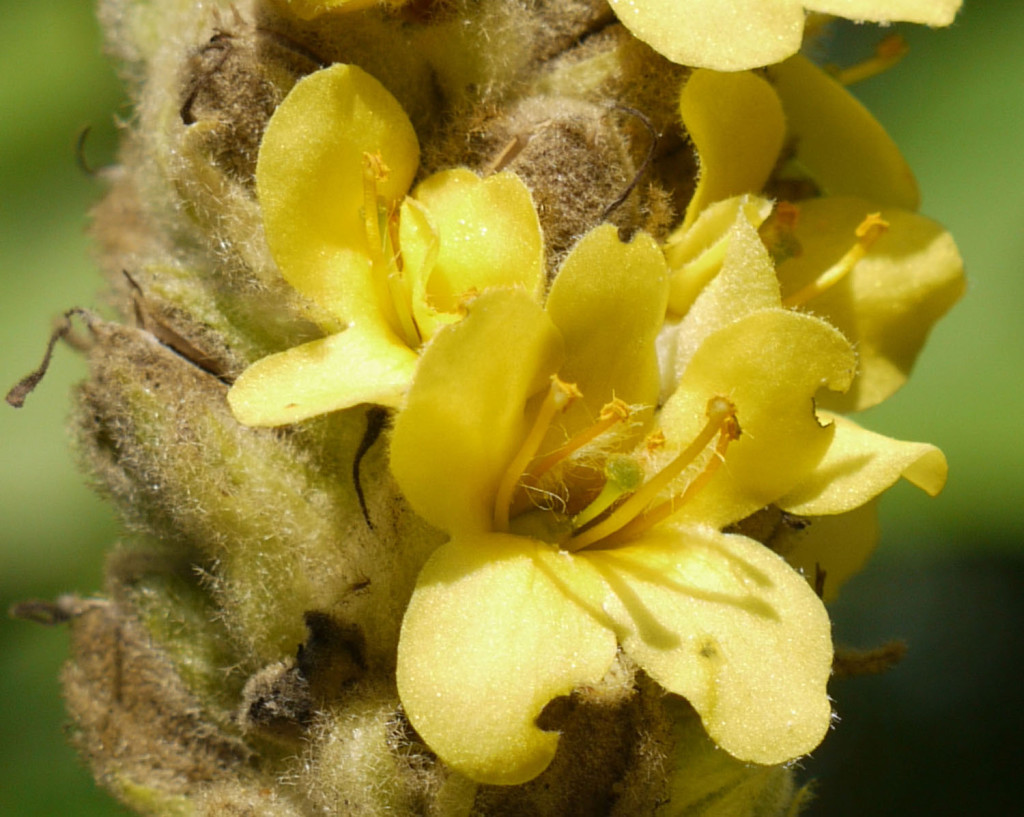 The flower of Common mullein (Verbascum thapsus) is quite striking when you look closely at it.