There are three plants which usually arise and bloom in late winter and early spring. They tend to be confused in their identification since the flowers are similar in color, the leaves seem to be the same shape and size, and the height of the plants are nearly the same. Let’s look closely at each of these three plants and see how they are different — to make their identification more certain when you next encounter them.
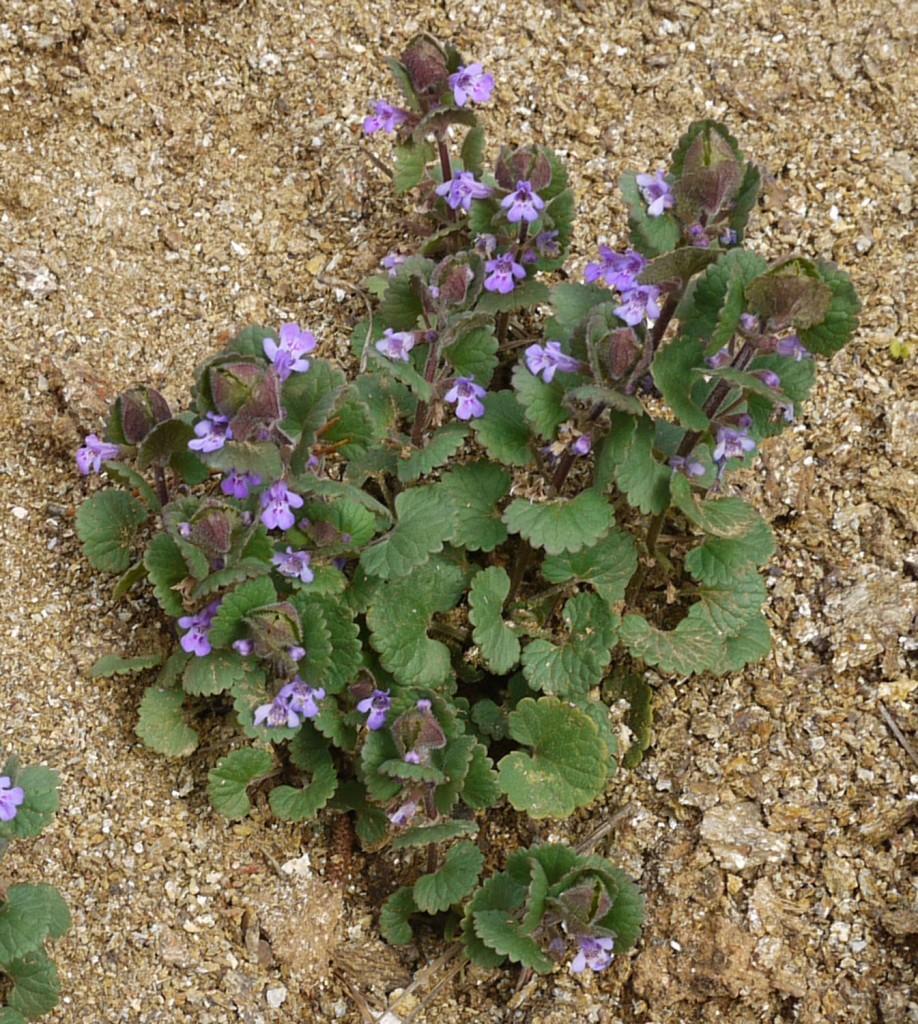 Starting with Ground ivy (Glechoma hederacea) . . . This plant has many common names. Some other popular ones are Gill-over-the-ground and Creeping Charlie. All three common names hint at this plant’s growth habit: low and sprawling like ivy.
 The leaf shape is round and is sometimes classified as nearly kidney-shaped. The leaf edges are “scalloped” or “bluntly toothed.” The veins are noticeable and mostly palmate.
 In the next photo you can see some older yellowing leaves. Also noticeable are the hairs on the leaves. The stalked leaves grow opposite each other along the stem. If you bruise the stem or the leaves, you will detect a strong aroma. Ground ivy is a member of the Lamiaceae (Mint) family.
 Let’s look at the Ground ivy flower. It is bilateral (or irregular) in shape — with lower and upper petal lips. (In this photo, the white areas on the petals are actually water drops.)
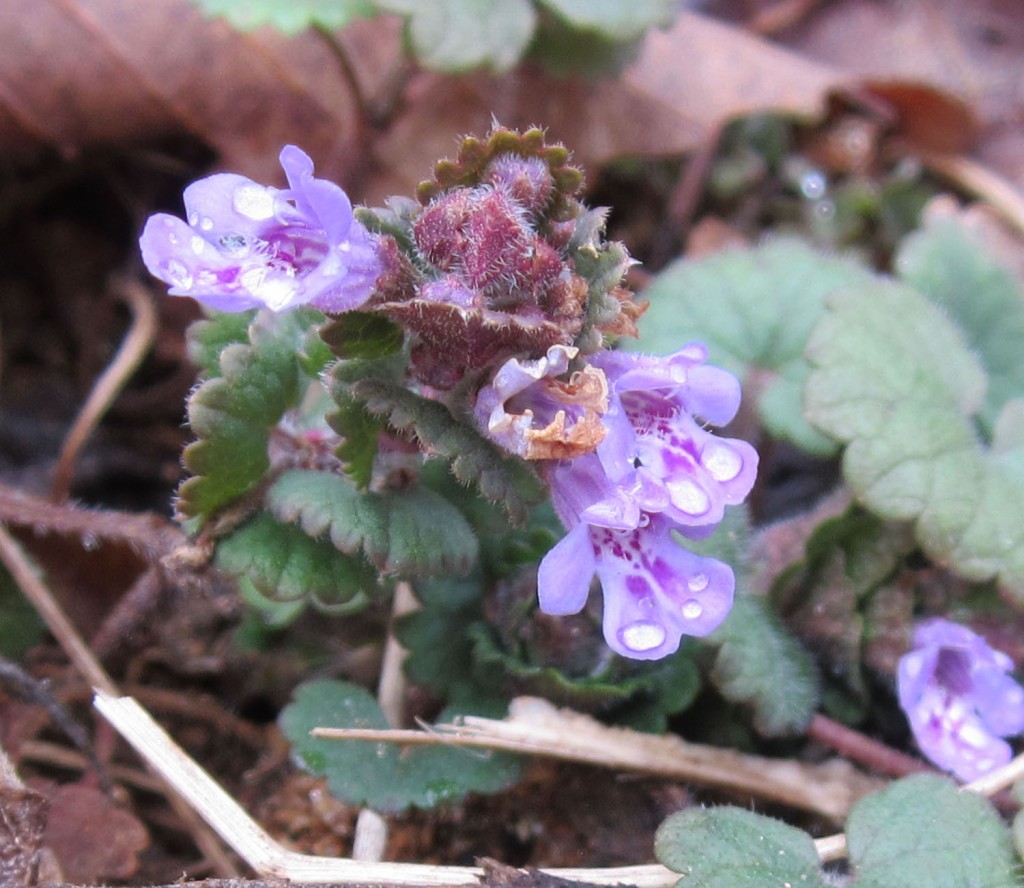 Here’s another image of the Ground ivy flower. The flowers grow in whorls from the plant’s stem.
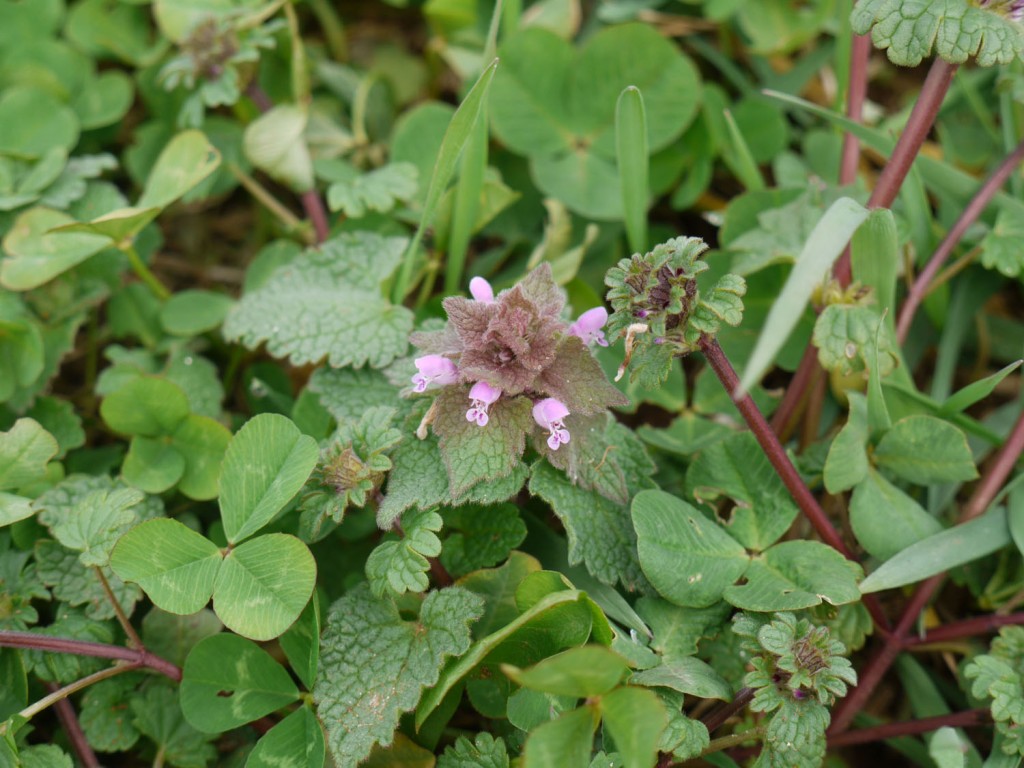
 The second plant is another hairy one — which can be mistakenly identified as Ground ivy. This is Purple dead nettle (Lamium purpureum).
 How can Purple dead nettle be distinguished from Ground ivy? First, let’s look more closely at the leaves.
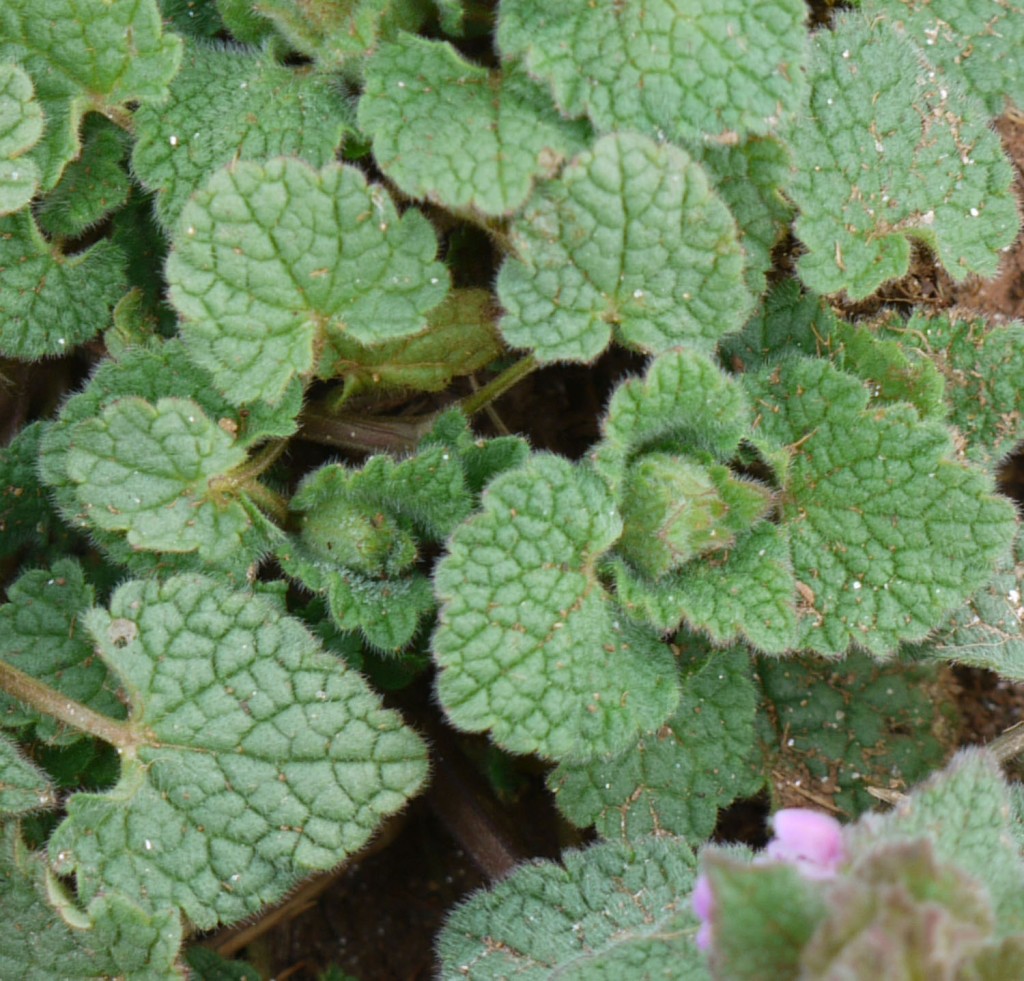 Although the venation looks almost the same, the leaf shape is more like a heart — less rounded and more pointed at the tip. Also, Purple dead nettle’s leaf margins are not as deeply scalloped as Ground ivy’s margins. Both plants’ leaves have stems.
Looking at the leaves at the top of a plant . . .
 . . . not only are they covered with hair, they also change color — to lavender — or even a purple shade. The leaves are arranged oppositely along the stem. The next photo provides a close look at the Purple dead nettle flowers. (Notice the upper leaves’ deeper shade of purple — or red.)
 Similar to the Ground ivy flowers, these bilateral flowers have lips. However, the lip structure is different. You may want to scroll up and down this post to compare the two flowers more carefully.
Purple dead nettle is also in the Lamiaceae (Mint) family. You can clearly see the square stem in the next image.
 For our third “looks similar” plant, we turn to another member of the Lamiaceae family.
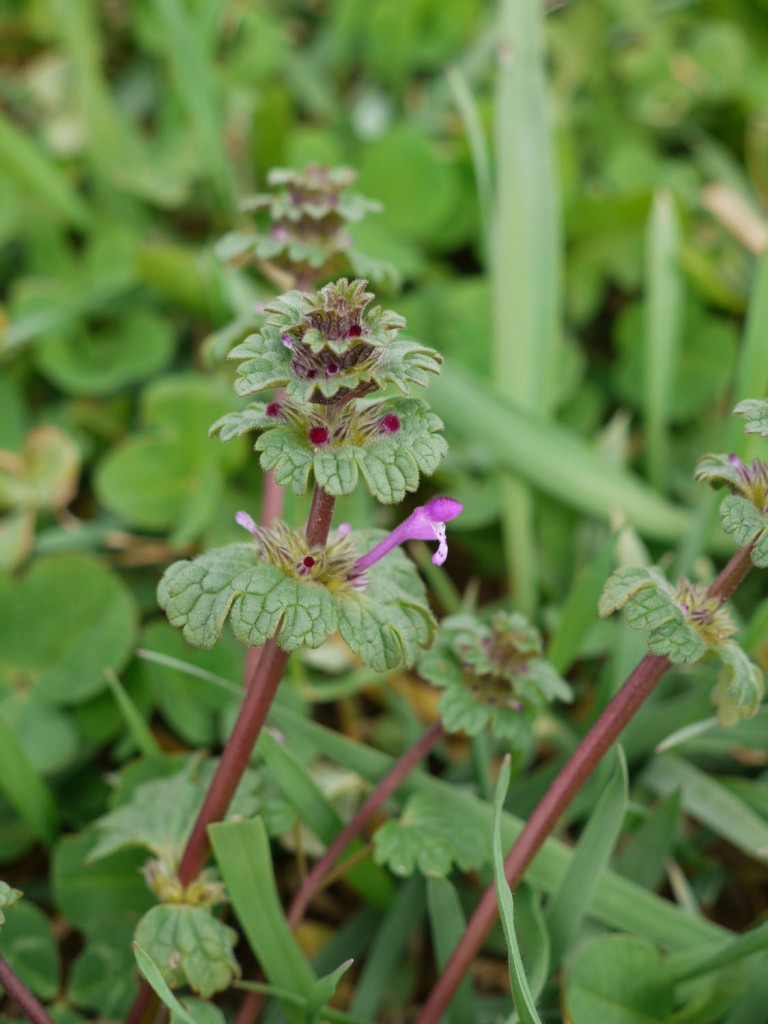 This is Henbit (Lamium amplexicaule). One of Henbit’s striking features is the stem color — a nice deep red throughout the length of the stem. The stem is also square. There are lengths of stalk visible between the sets of leaves.
So how are Henbit’s leaves different from either Ground ivy or Purple dead nettle leaves?
 The most significant difference is that Henbit leaves are in whorls around the stem. They also are sessile — without any little stems of their own. The leaf margins are deeply scalloped — far more than Ground ivy’s leaf margins. And . . . the leaves do not have hairs at all. Instead they look more glossy.
A closer look at the Henbit flowers reveals they, too, are arranged in whorls around the stem. This is most noticeable in the above image — where the flowers are still in bud.
 Henbit’s flower shape is remarkably similar to Purple dead nettle’s flower shape. This makes sense as they are both in the same genus (Lamium). However, there is one obvious difference between the two flowers.
 Henbit’s flower has a long tube portion which is clearly visible when the flower is fully open.
And just to keep you challenged — these three plants love to intermingle. Which plants can you pick out and identify from these last two images?