

Virginia creeper and poison ivy
People are frequently confused by these two plants when they are first learning to identify poison ivy (Toxicodendron radicans). Although the individual leaflets are similar, Virginia creeper (Parthenocissus quinquefolia) has five leaflets to each leaf while poison ivy has three. Let’s make some other comparisons between these “looks similar” plants.
Starting in the spring, here are photos of each plant as it begins growing new leaves:
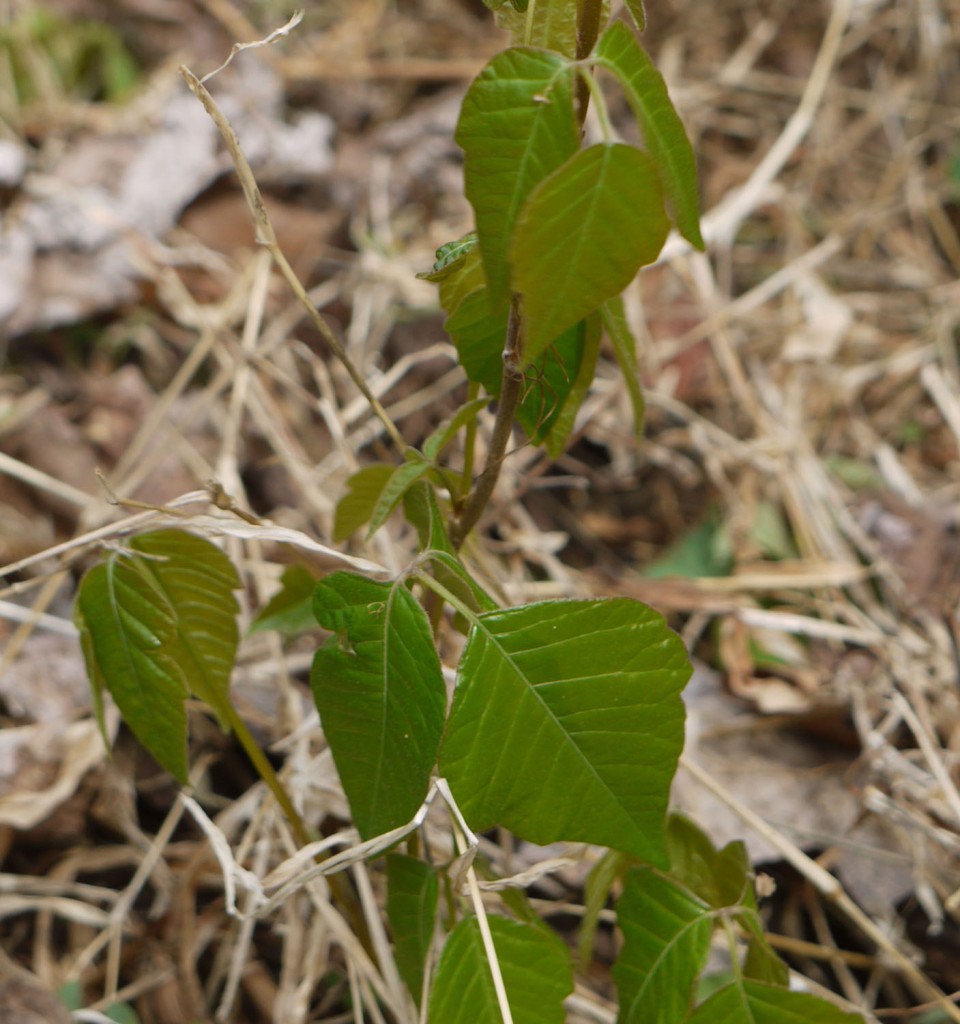
Poison ivy

Poison ivy
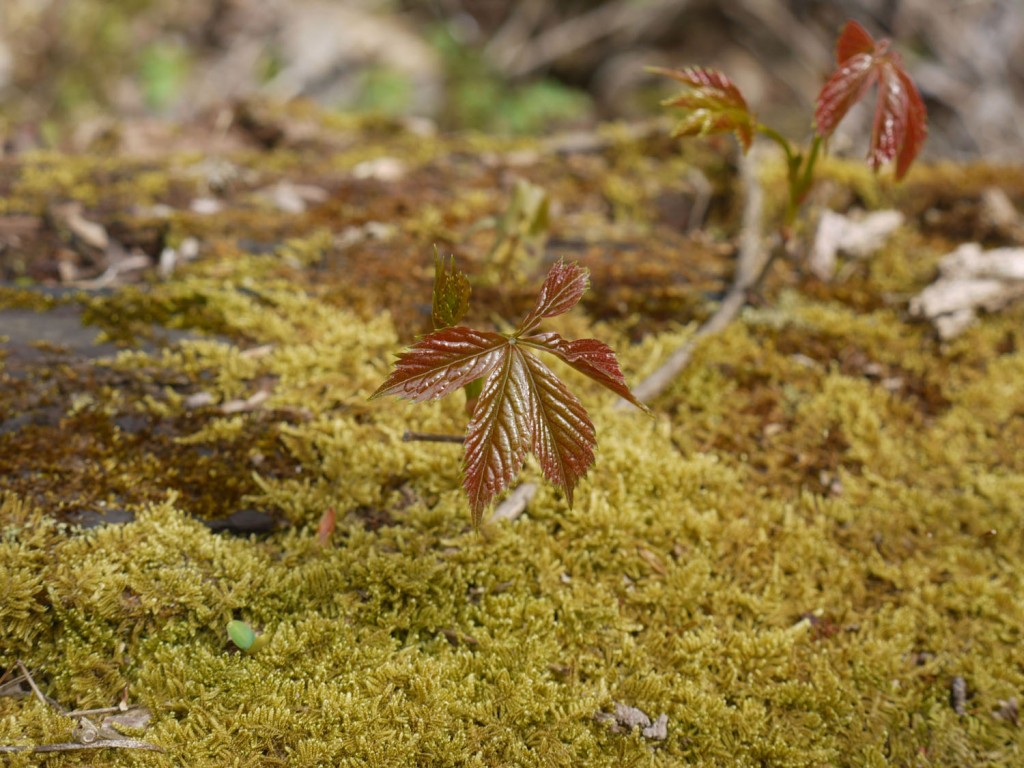
Virginia creeper
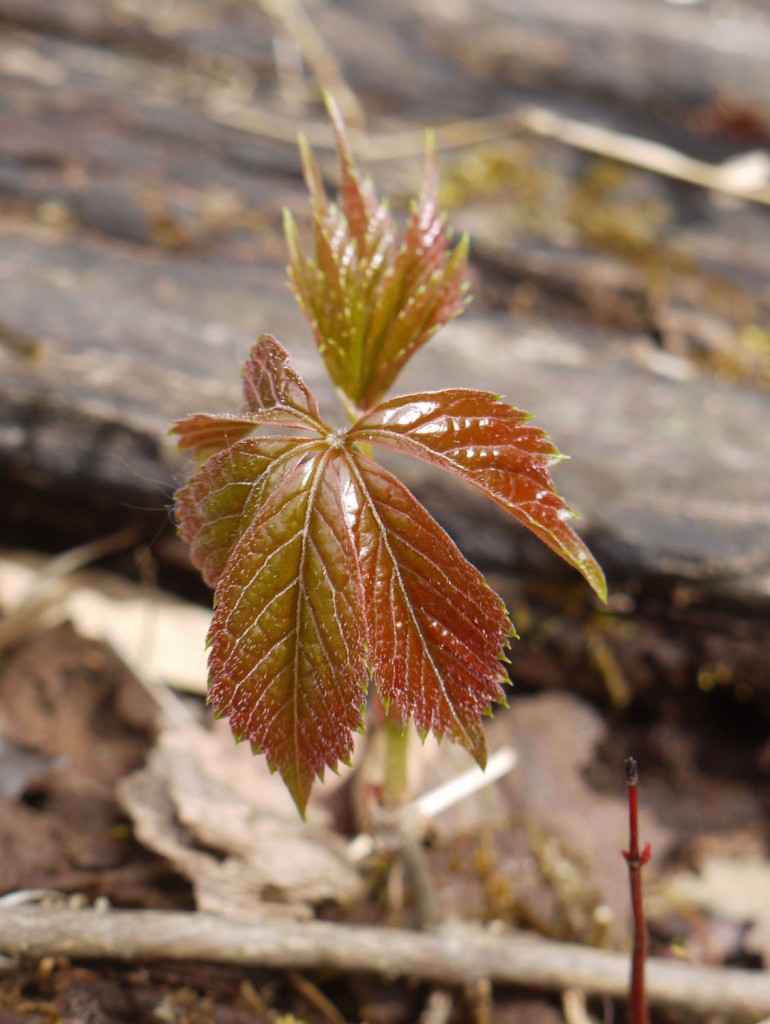
Virginia creeper
The leaves of Virginia creeper become green as they mature:

Virginia creeper
Here’s a full-sized Virginia creeper leaf with its five leaflets. Note the leaflets all meet close together in the center of the leaf.

Virginia creeper
In contrast, poison ivy has the three leaflets and the center leaflet has a petiolule (a longer “stem’):

Poison ivy
Here’s a cluster of poison ivy along the ground . . .
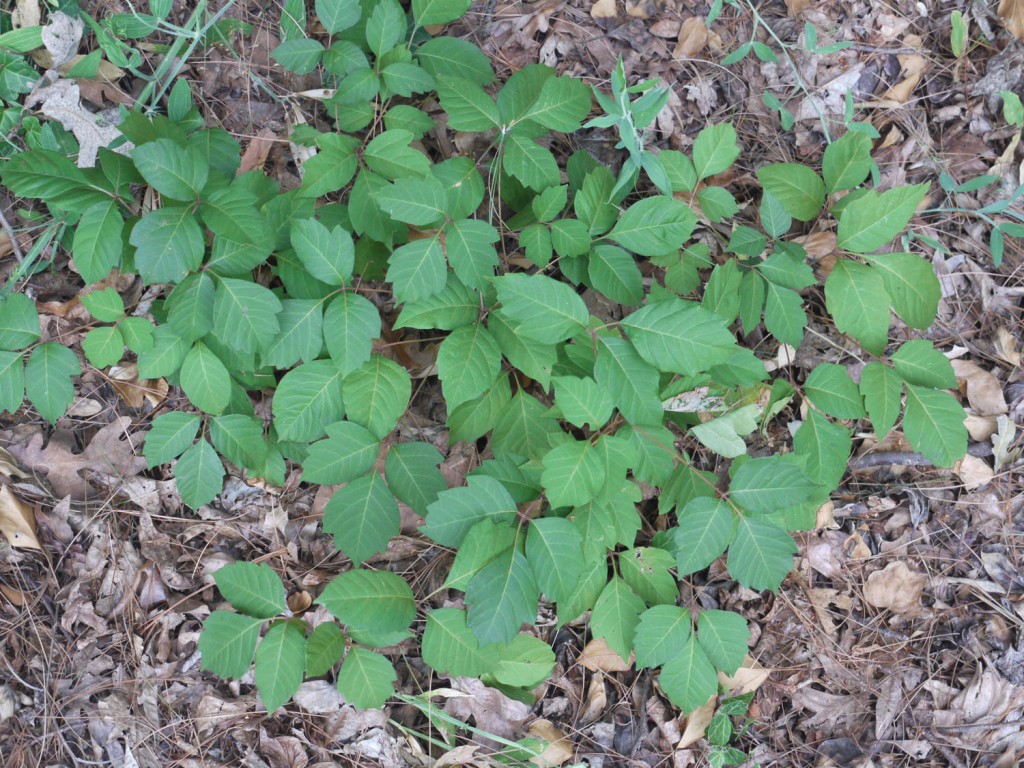
Poison ivy
. . . and some branches of it growing up a tree’s trunk . . .
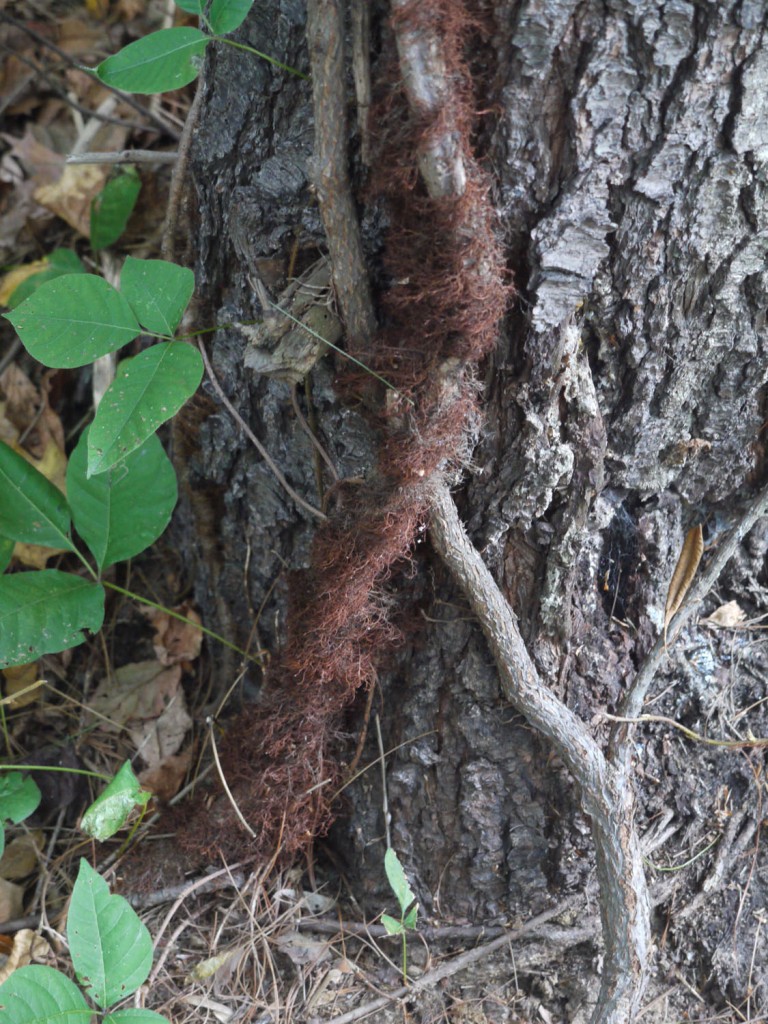
Poison ivy
. . . to a leafy canopy of poison ivy within a tree’s leaves:
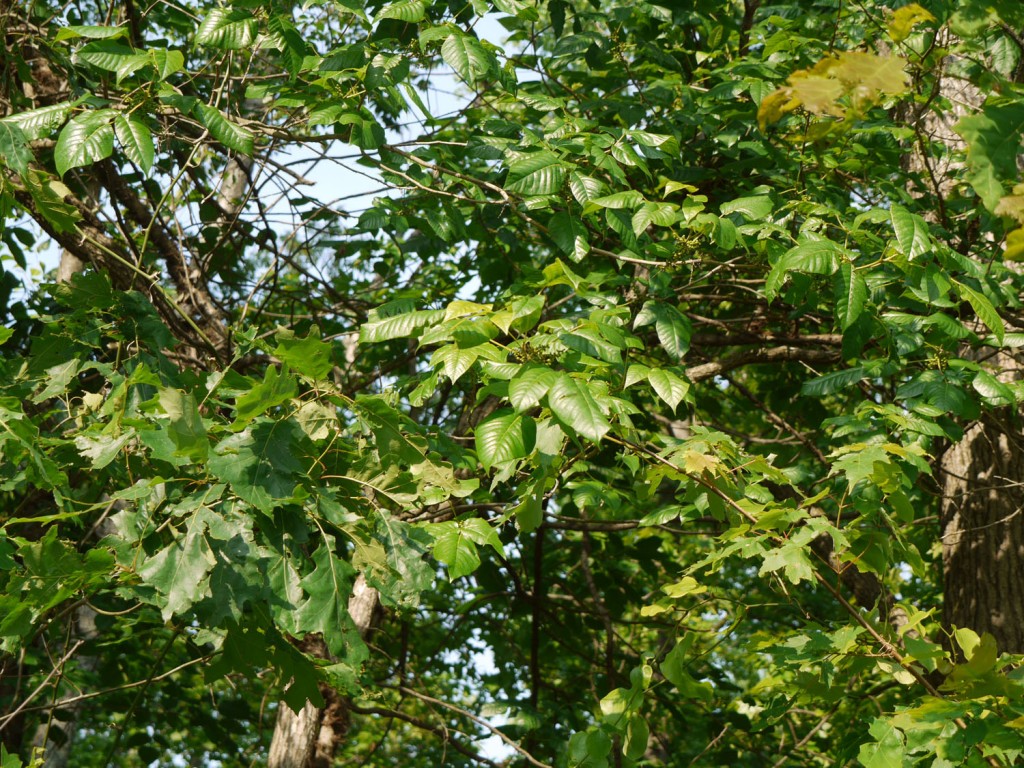
Poison ivy
Here are three examples of Virginia creeper growing along the ground . . .

Virginia creeper
. . . hanging down . . .
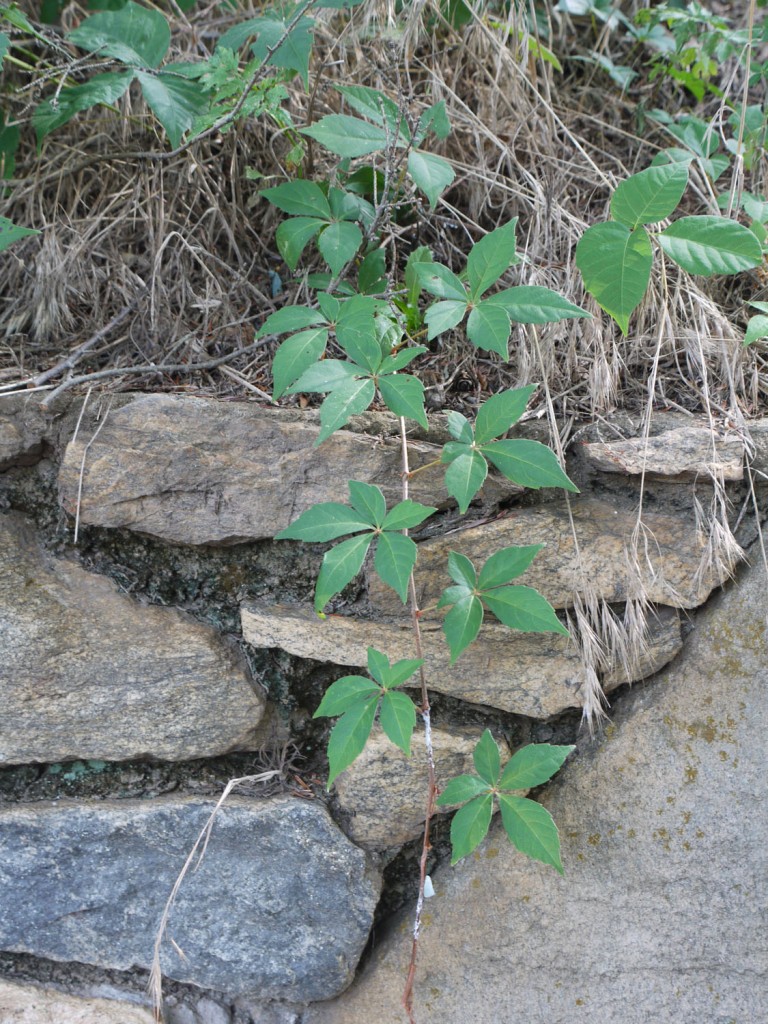
Virginia creeper
. . . and climbing a tree’s trunk:

Virginia creeper
As poison ivy’s berries develop, they are in a cluster. Eventually, the berries will turn white.
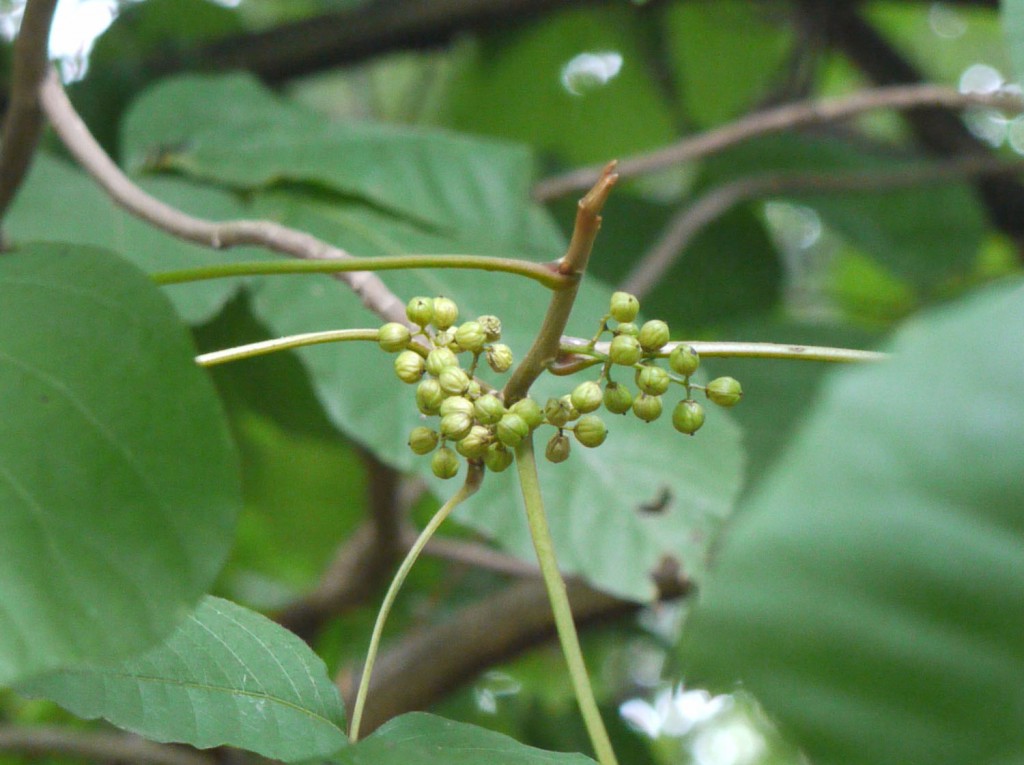
Poison ivy
The developing Virginia creeper berries, which will turn dark purple with red stems when ripe, look like this:

Virginia creeper
The leaves of Virginia creeper turn rosy and yellow as they age in the fall:
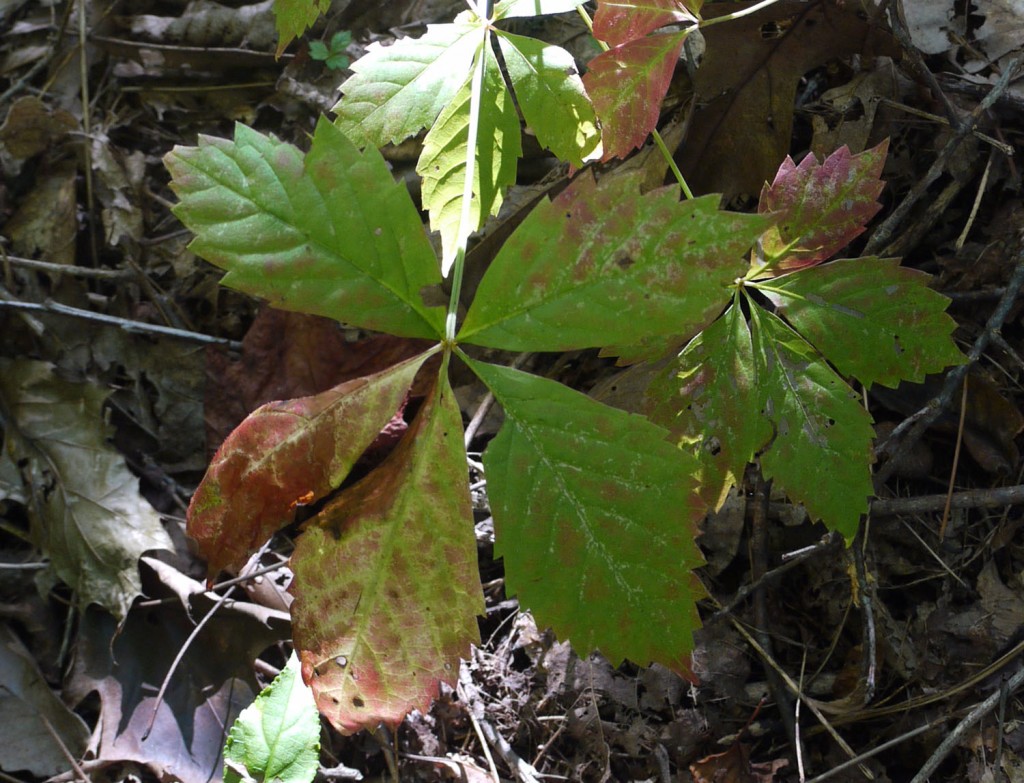
Virginia creeper
Similarly, poison ivy’s leaves also turn rosy and golden in the fall:
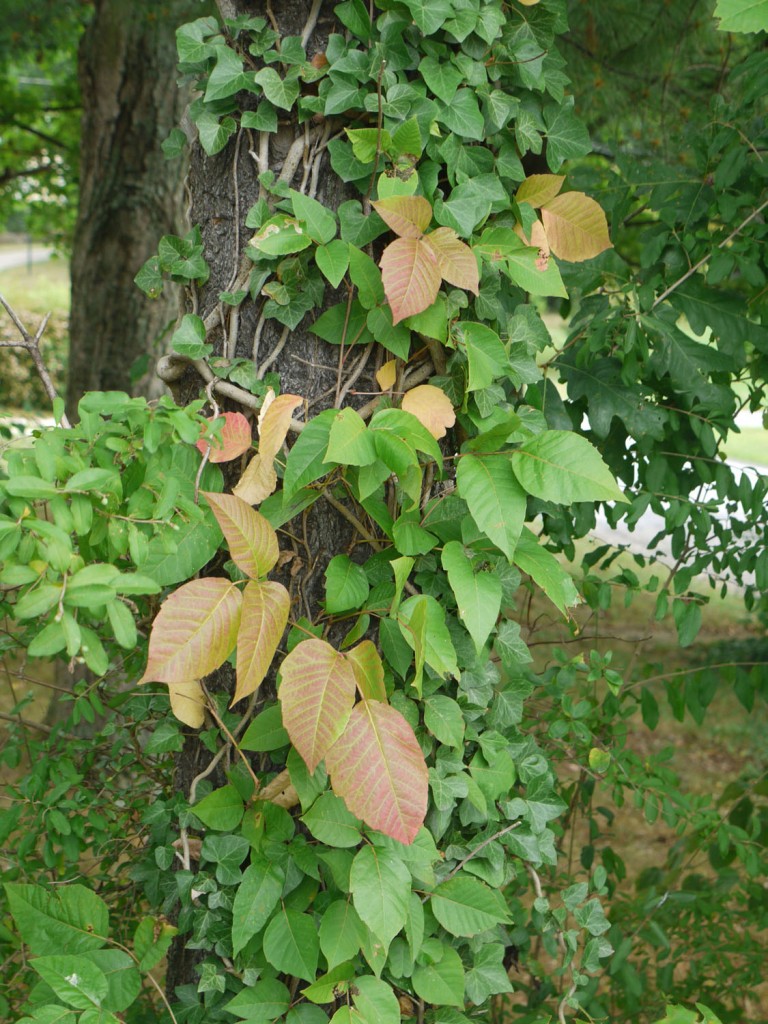
Poison ivy
When poison ivy climbs a surface, it develops a “hairy” stem which is most evident during the winter season.

Poison ivy
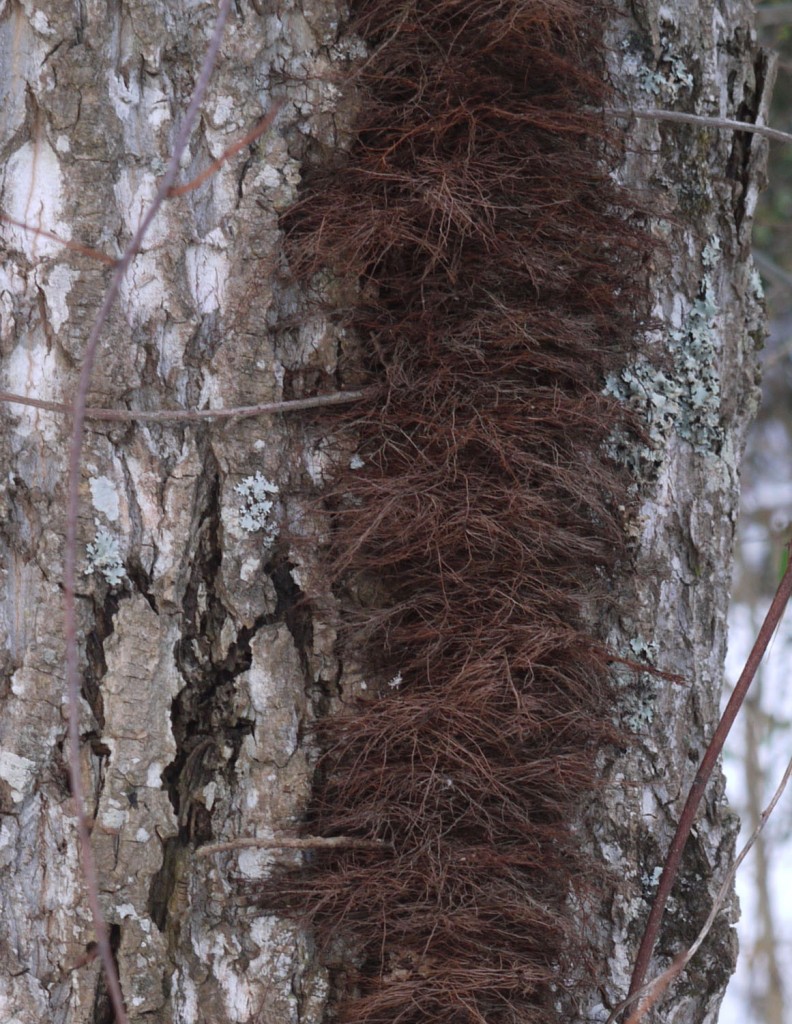
Poison ivy
Hopefully, this comparison has assisted you in developing a strong mental image of poison ivy (a hazardous plant) and Virginia creeper (which looks similar). And perhaps you will now be better able to identify poison ivy in all seasons of the year.
Angelyn,
Thank you for the information on poison ivy. Very helpful and excellent photographs!
Margaret
I agree with Margaret. Thank you very much for the well-written, greatly illustrated article! I had taken pictures in the woods I frequent of a plant I suspected of being poison ivy in hopes of taking them home to identify it. Your article was the first I came across, and I have now positively identified the plant as poison ivy and don’t have to continue researching. I am grateful. Kudos!
Thanks for the pictures of the poison ivy I am highly allergic to it. I hope to remember the pictures so I don’t get near it. What types of plants counter act it’s affects. You mentioned counter acting agents in your web cast on poisonious plants ? Thanks for all the help.
Billie, the remedy which works for me is Jewelweed (Impatiens capensis or I. pallida). I use it two ways: (1) Crush the plant’s juicy stem and leaves and rub the plant matter and juice on the skin area where I just came in contact with the poison ivy. This helps prevent getting a poison ivy rash. (2) Make jewelweed ice cubes which I then apply to a poison ivy rash to help it heal quickly. The coolness of the ice helps, too!
To make jewelweed ice cubes. . . Gather a bunch of the plant and place it in a pot with water. Heat the material and let it steep for 20 minutes or so. Strain out the plant. Pour the jewelweed infusion into ice cube trays and freeze. Store the jewelweed ice cubes in the freezer for months. (I’ve kept them for a year — until the next jewelweed season.)
I haven’t tried jewelweed for the rash. I’ve locked that one away for future use if (heaven forbid) I need it some day. I just suffered from the rash a couple of weeks ago, so I thought I’d share what cleared it up…faster than Calamine lotion. I took a (garden grown) cucumber, sliced a thin slice of it, and smeared the juice from it all over the affected area and left it to dry on. This cooled the rash and as it dried on it dried the rash out as well. Took about 4 days to clear the rash up completely!
I am also allergic to poison ivy. We found Roundup for Poison Ivy at walmart and it seems to kill it.
Someone on YouTube gave it a great metaphor. When it gets you, assume that everywhere the plant touched you is covered in axle grease. Use Dawn and COLD water. Dawn for the oil removal and cold water so the oil doesn’t get into your pores as much. This should PREVENT it to a point.
Thanks for the pictures. They were the best ones I’ve seen on the net. I wish you could tell me what to use in my flower beds to get rid of the stuff. I am highly allergic, so pulling is out of the question.
kay, I have heard that using salted boiling water is one way to kill poison ivy. I’ve tried this a couple times in the past — with moderate success. I’m not sure that I succeeded in killing the root. And I have recently learned that this method can also kill other plants because the soil has now become salted. Hhhmmm.
I, too, have a bad response to poison ivy. So when I find some which absolutely needs removal (my vegetable bed, for example), I wear long sleeves, long pants and gloves. I carefully dig the plant (and its roots!) with a shovel and maneuver it into a bag for disposal. I work slowly and mindfully to avoid any personal contact with my clothes or the handle of the shovel. Then I wash all my clothes, and if I feel it is appropriate, take some of the rhus tox homeopathic.
If you believe that is too risky for you, I suggest hiring someone else to pull the plant and its roots — or find a willing friend who does not have such a strong response to poison ivy.
You should only spray the salt water on the leafs . one or two applications should do the trick . I have only occasionally had the plant come back from the roots . If so just reapply .
To make the salt water solution ; Heat the water just below boiling , add salt until it no longer dissolves . place the mixture in an atomizing container and spray on the leaves .
Thank you for the very helpful information with photos. I now am certain that I have Virginia Creeper growing up my porch post.
Thank you so much for these pictures! My grandmother was letting virginia creeper grow rampant and I thought it was poison ivy. With much arguement I gave into her and believed it was ok. After she passed, I proceeded to pull it out! While it definately is Virginia Creeper I am still Definately allergic to it! I have broken out in a very bad full body rash. Taken the shot, steroid pills, and creams and also spent a ton of money on the Technu body clensers. My daughter had great success with the Technu wash with poison ivy, cleared it up in two days. I think rubbing in the stuff actually spread mine. The wash did nothing and the shot and creams are slow working and the rash is still spreading!! Please still observe caution with Virginia Creeper!!! So thankful I know what it is exactly now!
Be careful, I have poison ivy growing in with my Virginia creeper. Our old family cure for poison ivy is to coat it with a thick layer of bar soap which has sat in water until the under side has become soft. This seals the poison ivy infected area and dries it up in only 2-3 days. Also helps reduce the itch, so much more effective than calamine lotion.
I would rather roll around in a whole pile of poison ivy than mess with Virginia Creeper. I am not allergic to poison ivy. It generally has no effect on me at all, and the only time I’ve ever been effected by it is when I’ve worked in it all day and (without thinking) scratched itches, rubbing and pushing the oils into my skin! Even then, I’d only get a very mild rash that wouldn’t last long, maybe a day or two. Be aware that if you are allergic to it, you are allergic to the urushiol oil, btw, so do not burn the plant or vines as the smoke will be irritating to you, and do not attempt to deal with the plants without protection even in winter as the oil is still in the vines/roots even when dormant (I’d guess that it’s safer then, but I have known people to still get it by cutting the roots in the dead of winter, no leaves on the plant!)
Unlike poison ivy, Virginia creeper is ok if you do not get the sap on you. It probably won’t get you if you only brush against it. However, I had several trees being strangled by the junk … a walnut tree and a beautiful Japanese maple… and I decided to wage war. Everybody told me that it was a ‘safe’ vine. I also counted on my history of not being allergic to plants (I don’t press my luck, but I do not react), and I thought I was safe. Well, hours later, I had cut and yanked and decimated these vines and managed to save two or three trees. And soon (within another couple of hours) found myself covered in horrible painful rashes. At first I thought that it had to have been poison ivy and that I’d developed an allergy… but it’s not the same thing. Upon researching it, I learned that this plant has calcium oxalate crystals in the sap. These things crystalize from the sap and cut/embed themselves in your skin like tiny bits of glass. Anybody is susceptible as it is physical damage, not an allergy. Also, because it’s like a large ‘open’ wound(s), you are vulnerable to infection from other contaminants as well… and let’s face it, you’re in the garden, you’re going to have dirt on you. I looked like I had actual burns covering my arms and neck!
Anyway, I am not an expert or a doctor or anything, but I had, sort of accidentally, done the right thing treating myself, even before I knew I had the rashes(!), by hosing off (totally soaked myself, clothes and all) before going inside, and immediately hit the shower. After the rashes started appearing, I also resisted any harsh ‘home remedies’ that might have further damaged my abused skin. I used bactine and anti-itch cream, which burned, so I switched to neosporin instead. I ended up going to the doctor who prescribed an antibiotic cream and a course of prednisone (corticosteroid) to help me through the worst of it. Basically, I just had to wait until the spines cleared out of my skin. Many showers were taken!
As I said… bring on the poison ivy… roll roll roll… !! Be careful cutting those vines! I think that, had I been wearing long sleeves and long gloves, I’d have probably been ok, but I was in a short sleeve tee on a hot day. Bad idea.
Is the Virginia creeper a poison or not? Thanks for the info.
Kevin, typically Virginia creeper is not poisonous. I have read before of cases such as Becky’s where a person has a negative reaction to it. My understanding is that such a response is uncommon.
Please don’t advise that Virginia Creeper is usually not poisonous. Like Becky, I am highly allergic to it. Like Becky’s grandmother, many people are not allergic to it. I advise an abundance of caution.
Hi dear,
Please,please be careful about Virginia creeper it’s worse than poison ivy,don’t cut it with regular garden cloves,where disposable one,the treatment is up to the amount you exposed to,if it’s too much u have to get cortisone bill’s with as many as possible of Aloa Vera,if it’s small Aloa Vera,stay away from the stress,and apply some ice when the scratch weave attack.
Poison ivy and Virginia Creeper
Virginia Creeper has five leaves in a group to poison ivy’s three.
But they often grow in the same places.
Virginia Creeper is harmless and attractive (though a few people claim nasty reactions to Virginia Creeper).
i think that i have an allergic reaction to virginia creeper because three people including me walked into a plant that looked exactly like that two of us did not get a reaction but i did. is that very uncommon for people?
Tameka, some people do have a negative response to contact with Virginia creeper. If you google this topic you will find lots of people’s thoughts about it. From what I’ve read this is not technically an “allergic reaction” from an oil such as the urushiol in Poison ivy. Rather, it is the calcium oxalate crystals which penetrate the skin, especially open skin. Plantain (as a poultice of mashed leaves) is a great plant for bringing up any embedded splinters, slivers, and probably calcium oxalate crystals.
Plantain is my go-to for skin irritations of all sorts. I’m currently curing my daughter’s eczema with it, for instance. I tried it on poison ivy to no avail, but I believe that’s because the poison ivy rash is akin to a chemical burn. I believe it may prove helpful in removing the calcium oxalate from the skin, per Angelyn’s suggestion, and it will likely clear up the irritation and provide relief pretty much immediately from the itch. It’s the remedy from ancient times for all manner of bug bites, including poisonous insects such as bee stings and spider bites.
I too am highly allergic to the Virginia Creeper but I feel that it is more with the root system. My husband told me it was not poisonous and I had nothing to worry about when the roots hit my bare leg. I took a shower after working in the yard and did not think about it again. Well, I woke up the next morning to bumps and rash all over my legs. It itches and I am currently trying to get in to see a doctor.
After doing yard work I have greatly reduced my breakouts from Virginia Creeper by rubbing Dawn dish detergent on any exposed skin BEFORE using water and then letting cool to warm water flow over the skin. I don’t remember where I learned that cleansing method, but for me, it works as well as technu and is a lot more affordable.
I too have had a very bad reaction to Virginia creeper vine. The doctor who diagnosed me said that it gets into the blood stream and can take up to six weeks to go away. After a couple rounds of steriods, lots of hydrocortisone cream, and a heavy duty antihistamine so I could sleep it took just over six weeks to go away.
Pingback: Poison ivy, Virginia creeper, and other condundrums | Natural Gardening
The leaves on creeper are jagged posion ivy’s leaves don’t have as much as a jagged edge as creeper.
Alos the 5 leaf kills the 3 leaf. If you do get poison ivy on you and creeper is around, take the creeper and start rubbing and crumbling over the ivy. You want the oil from the creeper to go over the effect area of where the ivy is on your skin. This should and has for me stopped the rash.
I’ve seen quite a variety of toothiness to Poison ivy’s leaf margins. Sometimes they are smoother as you say, sometimes quite sharp.
I understand that rubbing the Virginia creeper leaves over your skin where you’ve been exposed to Poison ivy helps you. However, I do not recommend this method to others since there are some people who have severe reactions to Virginia creeper (as noted in some of the above comments.)
I must admit I am among the many who thought it was poison ivy…lol…..thank you for sharing your knowledge
Thank you, this site has been most helpful, however, it confuses me that most all the sites I looked up have stated that poison oak and sumac not common to Midwest? I have been diagnosed as having all three at once (passion for hunting arrowheads), and have identified all three at family farm in NE Mo, as well as here at home in mid-Missouri…we do also have jewel weed and excited to know how to use it, so thanks again!
You have a wonderfully simplistic and informative blog. Thank you for sharing your knowledge regarding poison ivy and Virginia creeper identification. I have both, but I’ve only attempted removing the poison ivy plants and roots.
Thanks! Have both Poison Ivy And Virginia Creeper growing together on ground as well up a few trees at my house. Very helpful in distinguishing the 2 and wanted to remove the poison ivy if possible although idk how I would get the hairy vine off the tree. Also didn’t know the hairy vine was poison ivy as well. Thanks again!
Hi Julia, if the hairy root/creeper is really thick, you have to carefully saw it off. Otherwise if it is finger thick you can simply snip it at intervals with heavy duty secateurs. Mine was wrist thick and I had to carefully saw them through being careful not to damage the bark. Sadly I lost 2 trees to the ivy, where it had completely engulfed the tree. It will never happen again. My bites mostly on my neck and face, big lumps ! are from the insects that live in the stuff and not from the ivy itself !
I had a mysterious vine growing up my stairs and saw the red stem on the new leaves, immediately thought it was Poison Ivy. Thanks to the photos and comparisons, I was able to deduce that I have Virginia Creeper! It was the number of leaves, blossoms, and mature stem that gave it away. Thank you for the information!
Virginia creeper is a very common ornamental plant. When you see “ivy covered walls” (like at Harvard), it’s usually Virginia Creeper. It grows fast and easy, and can be a pest if you don’t want it. It clings well using little pods that stick, and doesn’t dig into wood or brick, making it the best ivy for homes as it is non-destructive.
How do you get rid of Virginia ccreeper permanently?
Thanks
I pull it up, making sure to get as much of the roots as possible. Sometimes I may need to go over an area more than once because I had not gotten all the roots.